| 21 |
|
| 22 |
1917 -- Melba L. Tucker was born. [She would go on to become an influential
figure in California circles of bonsai and suiseki.]
(SSN Master File by Birthdate)
SEE ALSO: Aug 26
1991 -- Gambia issued a set of 8 postage stamps plus three souvenir sheets to commemorate Phila Nippon '91. Walt Disney characters play Japanese games and sports. One stamp, which shows Donald Duck and Mickey Mouse playing go (notice the gameboard), has a 3-tree bonsai planting as a decoration just above and to the right of the center of the stamp. SEE ALSO: Jan 23, Jan 29, Feb 3, Feb 16, Mar 1, Mar 27, Mar 31, Apr 3, Apr 6, Apr 18, May 6, May 29, Jun 16, Jul 20, Aug 20, Sep 22, Oct 1, Oct 4, Dec 9. |
| 23 |
|
| 24 |
1929 -- The woman who would be known to us as Iris G. Cohen was born in Brooklyn, New York.
[She would go to Forest Hills High
School in Forest Hills, Queens, NY, becoming its salutorian in 1947. She would then move in September
1948 to Richmond, VA where she would study Art education at Virginia
Commonwealth University in the class of 1951. In late October 1952 she would marry Elihu Cohen, who
was a consultant for General Electric. She then would study Social Work at
Syracuse University, through 1969. As
she would later comment, "In my first social work job in 1955, I had to dictate my reports on a machine with wax
cylinders. I wrote my Master's thesis by hand and it was typed on a typewriter by a professional
typist. 72 pages. We bought a Mac Plus in 1986. Before that my husband used to bring home a
terminal from work that ran off our IBM electric typewriter. I could never master
DOS." She would work until a hip injury forced her to
retire in 1986. [Iris would attend the NY World's Fair in 1939-40. Her "most vivid memory was the introduction of fluorescent lights. The 1964 Fair was bupkes in comparison." [She would be an orchid fancier and would often gave specimens to friends, along with planted iris, sedum, or epimedium. The "little old Jewish grandma" of bonsai would start with that interest in 1989 (almost 24 years after starting to grow orchids), and would be growing trees indoors under lights every since. Her trees would include a pomegranate and an olive, in addition to maple and pine. She would be an early member of the Internet newsgroup rec.arts.bonsai, which would later be renamed as the Internet Bonsai Club. She would be known for her knowledge of and being a stickler for accuracy of plant scientific binomial names. A Macintosh computer-using Conservative Jew, Social Democrat, and LGBT advocate, she would write a few articles for the bonsai specialty magazines: "Bonsai for the New Year of the Trees," Bonsai, BCI 33(3):13 ['94]; "The Madagascar elephant tree: Operculicarya decaryi," International Bonsai, IB'98(4):34 ; and "Growing & training grewia or lavendar star flower bonsai," International Bonsai, IB'01(4):19. She would also author "Thread Grafting Ficus, or Almost Anything Else," for The Ficus Forum. She would be a member of The Bonsai Society of Upstate New York and the Mohawk Valley Bonsai Club, in addition to the Central New York Orchid Society. On January 14, 2011 Congregation Ner Tamid, North Syracuse, NY would have a bonsai display by Iris in honor of Tu BiShevat, the New Year of the Trees in conjunction with the Sabbath services and potluck dinner. RJB would briefly meet her in Denver at the June 2012 ABS convention there. [In the middle of April 2015, Iris and Elihu's car would be totalled in a car accident. Elihu would be shaken and bumped but otherwise O.K.; Iris would receive a broken right elbow from hitting the passenger door, and the seat belt would hit an old rib injury that then would give her more pain than the elbow. She would have a nursing aide two hours a day, five days a week, through the end of July. In early February 2016 Iris would be at a neurological branch of an upstate hospital due to a stroke. A month later Iris would be back in the hospital with low blood pressure and heart problems. That September, however, she and her husband would attend the 5th U.S. National Bonsai Exhibition in Rochester. In mid-June 2017, she would have what was believed to have been another stroke.] (assorted postings from her FB page from 2014 through 2017; "Iris Cohen," syracuse.com; Wright, Gloria "Tiny trees: Bonsai have deep roots in history," The Post-Standard, Jan 08, 2011; "Growing Bonsai Under Lights With Iris Cohen," Mohawk Hudson Bonsai Society Newsletter, Volume 42 Number 10, October 2010, pg. 1; Duffy, Lori "Parents Once Again, An Increasing Number of Grandparents Are Taking Responsibilities for Their Children's Children," The Post-Standard, Nov. 18, 1996, pg A1.) SEE ALSO: Apr 9, Jul 28 1967 -- The Gold Coast Bonsai Club was organized in For Lauderdale, Florida. Louis Strycharz was elected president and James Blackwell was named secretary-treasurer. ("Announcements," Bonsai Journal, ABS, Fall/Winter 1967, p.13) 2014 -- Tasmanian-born Carole Waller had her Pinus canariensis bonsai on display at the BCI/AABC International Convention on the Gold Coast from Aug. 21-24. (Taught the basics of plant care by her gardener grandmother, years later in 1977 she bought a beautiful little cedar bonsai at one of her visits to Ron's Nursery. Thus began her lifelong love affair with bonsai. Five years later Carole and her family moved to Queensland, Australia. (She would successfully complete a course with Dorothy Koreshoff in 1988, and gain a Certificate for Bonsai and Saikei on behalf of the Nippon Bonsai Society of Japan. Her studies would include a workshop with Masahiko Kimura. She would be involved with several clubs over the years and teach a variety of classes from Beginner-level to Advanced. From 1996 to 2013 she would operate the award-winning "Bonsai World," the Gold Coast's first bonsai nursery. The establishment had to close following several costly and heart-wrenching robberies. From early 2012 through 2017 Carole was on the Selection and Ambassadorial Committee for the National Bonsai & Penjing Collection of Australia (NBPCA), which is based at the National Arboretum in Canberra. In 2013, she donated her Callistemon viminalis bonsai to the permanent collection upon the request of the Curator who believed it to be the best bonsai of its species in Australia. Three other trees over the years have been on loan, each staying for about 1 or 2 years at the collection. (She was on the Planning Committee for Queensland's First International Bonsai Convention in August 2014. She was in charge of the design and layout of the bonsai display. Her friends had problems getting her Pinus canariensis tree in and out of her car and she jammed her fingers quite badly. They had to take the spare wheel out so they could fit the tree in her SUV. The tree wasn't one Carole had entered in the Convention for display and judging; instead she planned to use it in a display with another large tree where they were both to be lifted into place on a high ledge over a void with a scissor lift. The tree was on the lift with Andrew Selman when the batteries died and they plummeted back down. It was decided that it was too dangerous to try again, so Peter Woosley who was helping Carole with the set-up put it on a plinth in the room with the trees being judged. The moment's drama seemed so serious at the time, and it seems so insignificant and funny now. Carole had been discussing removing several branches with friend and Bonsai Master, Budi Sullistyo, and he agreed that she should remove them.) That evening during the dinner it was announced that the tree had been awarded a BCI Gold Medal, judged by Japanese Master Shinichi Nagajima. As she was walking up to collect the award Budi called to her and said, "Carole, don't cut anything off it!" [Chris White would later tell her "It is wonderful how God worked to make sure your tree won a medal." In 2016 during a wild storm the tree would be blown off its stand and the pot would be broken. The tree would live the next couple of years in a large plastic bin while Carole would search for an appropriate pot. A few years later she would remove several branches and a while after that teacher Boon Manakitivipart would help her lower the large back branch. The second last picture below would be taken after the work was done. The first picture's pot cost $80 many years ago and the second pot would cost $900 in 2018. It is just that you can barely see it because Carole would pad her pots in summer with styrofoam to act as a buffer against the hot sun at her home in Queensland. See also this series of short video "critiques by Carole at the Redlands Bonsai Show 2016 show, and these photos of some of her Myrtaceae bonsai.] 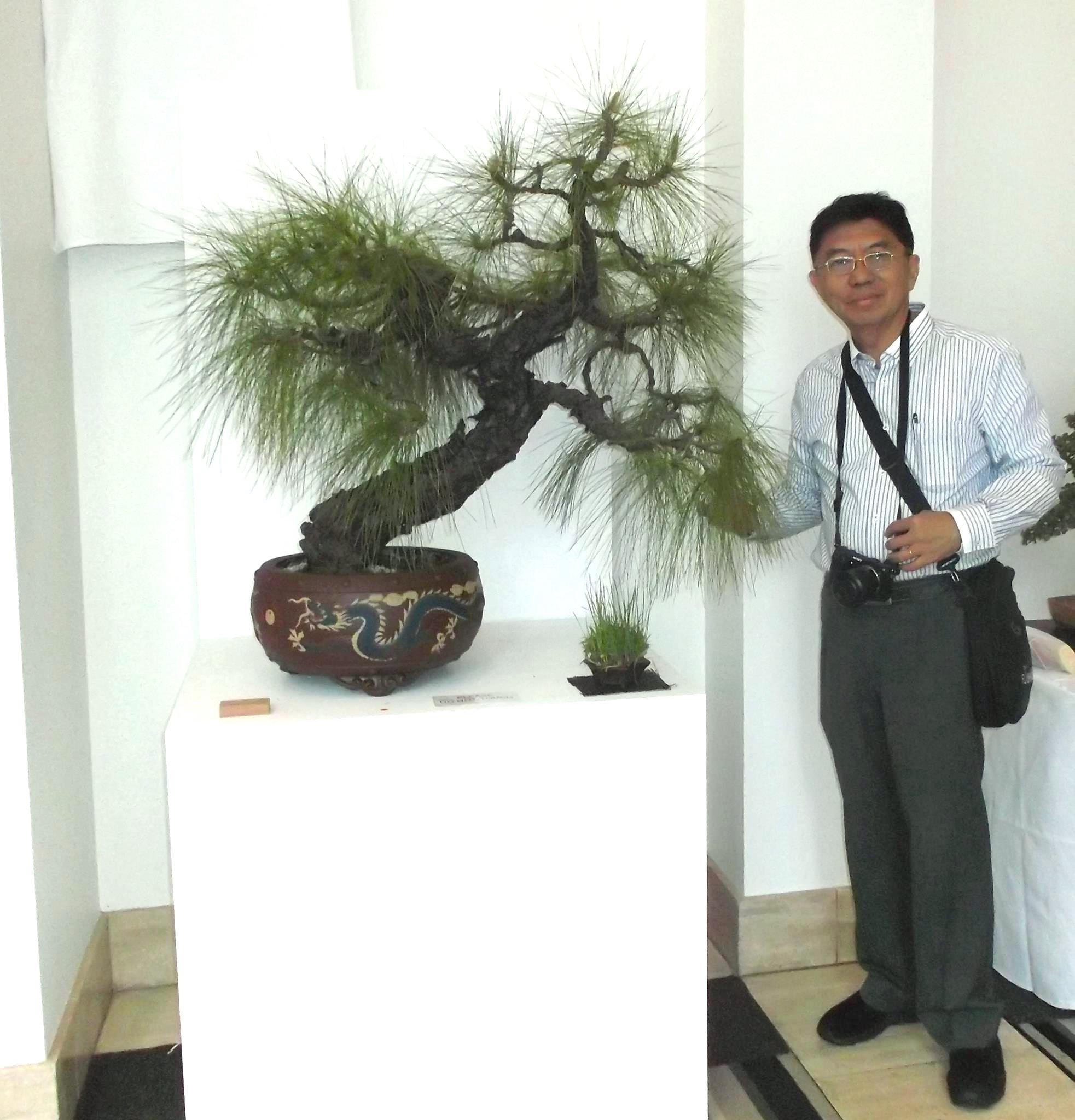
Carole Waller's Pine and Budi Sullistyo 2014 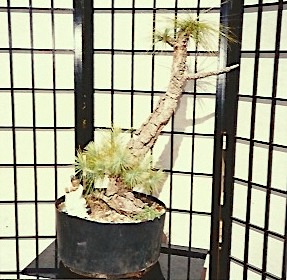
Carole Waller's Pine as Originally Gotten in 1992
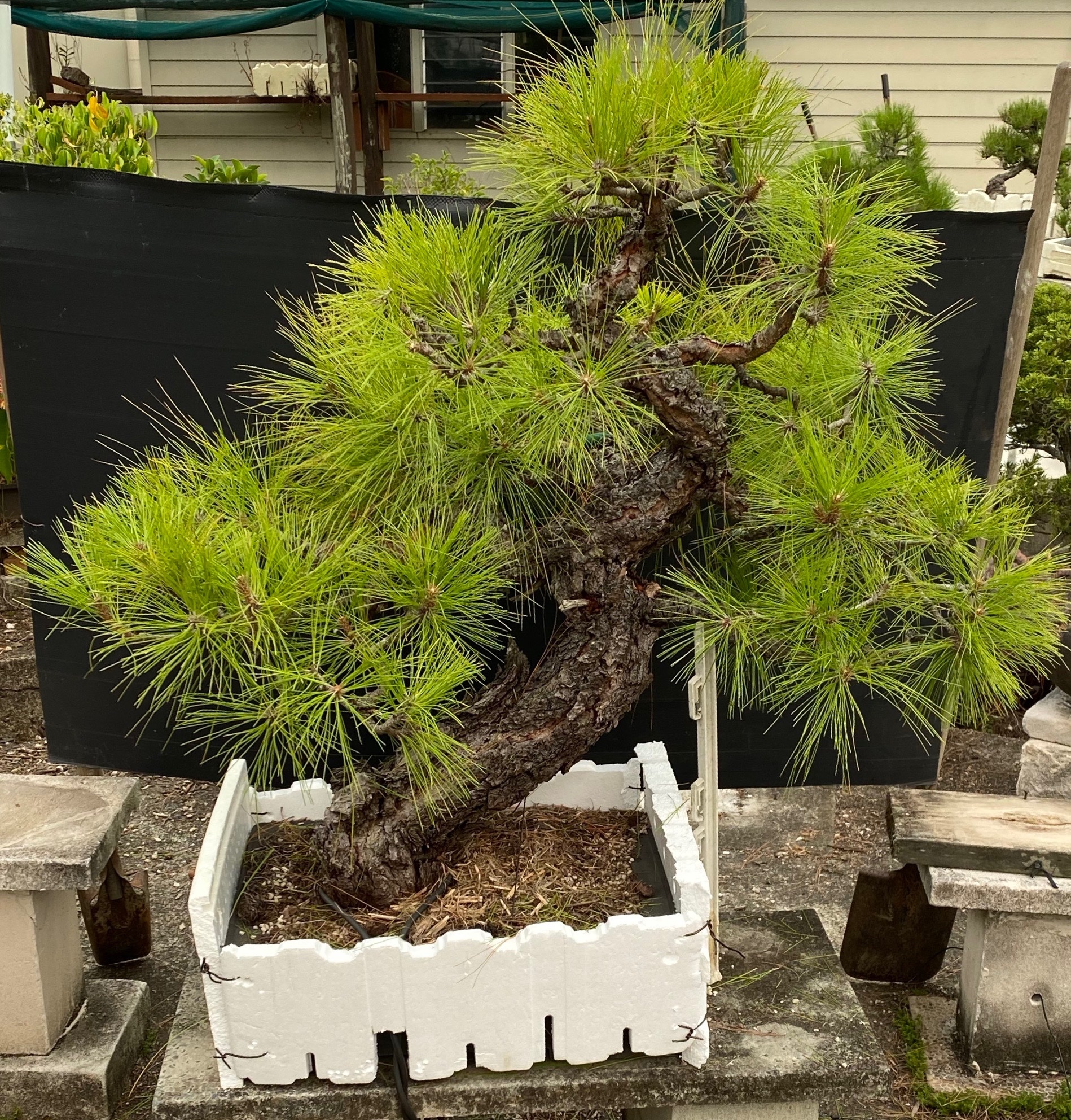
Carole Waller's Pine 2022
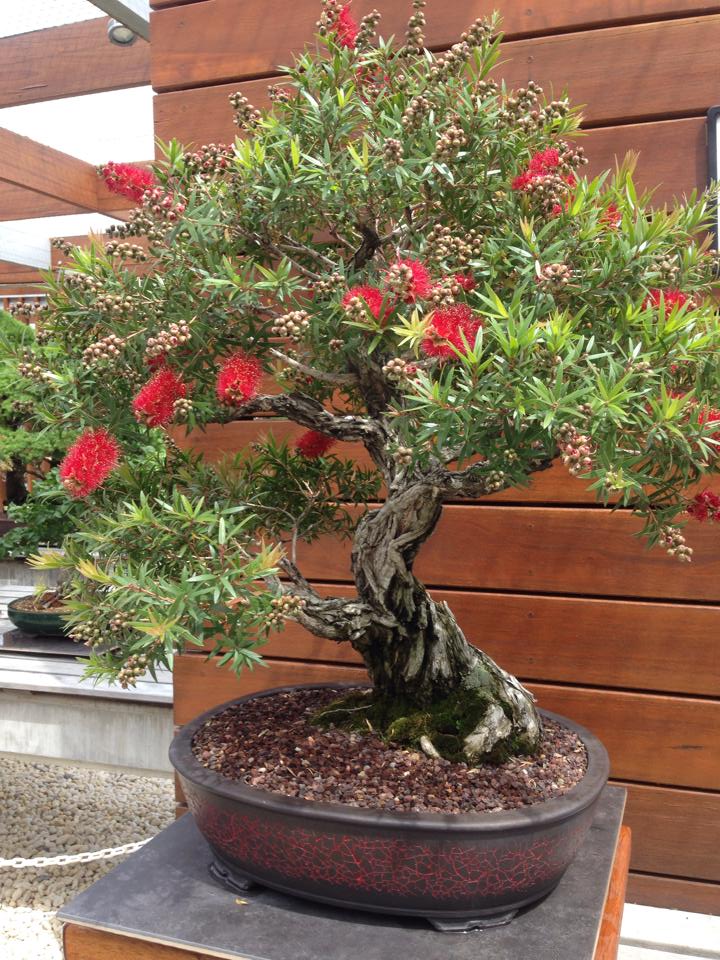
Carole Waller's Donated Callistemon "Captain Cook"
(Carole Naree Waller Facebook post and comments with 2014 and 2022 photos, August 25, 2022; slightly
edited draft and 1992 photo from Carole to RJB in FB Messenger, August 28; "The Artistic
Genius of Carole Waller," Bulletin Australian War Widows Queensland,
Summer
Edition 2019, pp. 8-9, which incorrectly gives the Koreshoff date as 1982, per Carole in FB Messenger
to RJB on September 1 along with Callistemon photo, additional details on September 2.) SEE ALSO: Jan 28,
Feb 22, Mar 31,
(Callestemon viminalis) |
| 25 |
1956 -- Henri Frits Vermeulen was born. [He would go on to be involved with bonsai in Michigan, Florida,
and Delaware, and hold several positions in the American Bonsai Society.]
("Henri Vermeulen, 61,"
https://www.mylife.com/henri-vermeulen/henrivermeulen)
SEE ALSO: Dec 12
2016 -- David Lynnwod Andrews, M.D., a highly respected surgeon, teacher, gardener and collector of rare botanical books, died at home in Alpine, NJ at age 85 after a long illness. (He attended the University School in Cleveland, near where he had been born in 1930, and then was a 1952 graduate of Williams College in MA. He married Nancy Byrd Bomar of Westport, Connecticut, in 1953. An orthopedic surgeon, David practiced medicine in New York for half a century at the Columbia-Presbyterian Medical Center and taught at the College of Physicians and Surgeons, where he had received his own training. He was recognized in 1999 as a distinguished alumnus in orthopedics. David was a dedicated supporter and board member of the New York Botanical Garden, and a member of the New York Hortus Club. He actively participated in the Century Club's Round Table and was a member of the Union Club. Drawn to the intellectual history of botany and horticulture, David explored the role of these natural sciences in colonial and early America, and built a comprehensive collection of books and ephemera from the period. The NY Botanical Garden's Mertz Library retains important volumes of his collection. David was inspired by science, but was at heart a pragmatist who trusted in the power of work. In 1982 after he repaired the hand of the pianist Billy Joel, injured in a motorcycle accident, newspapers quoted Dr. Andrews as saying that the best therapy would be practicing at the keyboards. The goal was not to be as good as ever, but better. "Life isn't always easy," he told a writer about his garden. "Sometimes you have to work hard to see the beauty in front of you. It's always a work in progress." His memory and teachings will live on in his many devoted residents he mentored and thousands of patients he cared for. David was an early student of Yuji Yoshimura and remained one for over 40 years. David loved bonsai, studied intensively, and soon became skilled and knowledgeable in many aspects of bonsai. William N. Valavanis had the pleasure of knowing David for over 40 years when they were both directors of the Bonsai Society of Greater New York. David was a 1967 charter member and a 1971-72 director of the American Bonsai Society. He had three articles published in the ABS Journal in 1973, 1979, and 1983. Large rock plantings and pines interested him and he became an expert in their creation and propagation. He frequently traveled to Colorado to collect flat and curved granite slabs. David often presented programs with Mr. Yoshimura. When visiting nurseries he always selected the largest specimens for training into spectacular large-size bonsai. As a past president of the Bonsai Society of Greater New York, Dr. Andrews frequently presented programs at meetings and conventions around the country because he loved the art and wanted to share with others. He was a speaker at the first American Bonsai Society Convention in Cleveland, OH in 1968, at the 1976 one in Philadelphia, PA, the joint ABS-BCI Convention in 1979 in New York City and a month-and-a-half later at an ABS meeting at U. of California Davis; also in 1982 at College Park, MD, in 1983 in Boston, and 1987 in Nashville, TN. He demonstrated at the Golden State Bonsai Convention in 1981, and at Bill Valavanis' International Bonsai Arboretum seminars in 1981 and 1983. He was also a participant in the Mid-Atlantic Bonsai Symposiums in 1985, 1986, 1992, and 2003. The Garden Club of America in 2005 gave Dr. Andrews the Medal of Honor: "Outstanding in the art of bonsai, in growing worthy and unusual plants, and in bringing together an unrivaled collection of American botanical history, you have made an extraordinary contribution to the field of horticulture." After his retirement, Dr. Andrews had not been actively involved with the bonsai community and planted all his bonsai into his large garden landscape. He told Bill Valavanis that he was going to move from New Jersey to New Hampshire, and in early 2014 wanted to give all his bonsai containers to Chase Rosade (a fellow ABS charter member) and Bill. It was very generous of Dr. Andrews to donate over 400 quality containers so that others could appreciate and make use of the pots he had collected and used for nearly five decades. They ranged from two inches to over three feet in length. Most of the containers were old Japanese from famous Tokoname kilns. Some of the pots even had old price tags from California nurseries which had gone out of business 30 years earlier. Some were originally priced at $3. It was wonderful that David continued to think about the future of the art and wanted to share his love with others. This gesture was typical of Dr. Andrews who had often traveled during the night to bonsai gatherings bringing large demonstration material, teaching and then returning to his busy medical practice in New York City. ("David Andrews Obituary," Legacy, Published by New York Times from Aug. 29 to Aug. 30, 2016; "2005 Medal of Honor," the Garden Club of America; "Dr. David L. Andrews, March 20, 2014; 2004 Indices, ABS, pp. 12, 23; Hawley, Doug "History of the ABS and Bonsai in America, Part 1: 1800's through 1967," ABS Journal, Vol. 51, No. 1, pg. 17) SEE ALSO: Jan 30, Sep 3, Nov 13 2020 -- Lionel John Theron died, an 85 year-old South African bonsai artist, dad, grandad, and husband to Gail of 58 years. A wise, kind, generous, very special man that was loved by all who came into contact with him, he had a great life and will be sorely missed. This would not have been possible without the love and support of their family. Gail has been growing bonsai since 1969 and was mainly self-taught. In 1970 there was very little information or contact with bonsai from other parts of the world for Gail and her fellow bonsai growers like the late Rudi Adam, Bernard Coetzee and Bob Richards. They were a small group of bonsai fanatics with no internet, no tools, pots or wire. Their bible was 1965's The Sunset Book of Bonsai. The year 1970 was also when the Cape Bonsai Kai was founded. Gail was trained as a radiographer, but gave up her professional practice because of her love of bonsai which occupied her time fully. She had two years training as a nurseryman at a very large garden centre in Cape Town in 1979 and 1980. As bonsai and Oriental arts had already been her and Lionel's interest for many years, they decided to expand their own nursery, and in 1980 purchased seven acres in the delightful Hout Bay valley in order to achieve this ambition which then grew from strength to strength. Also in 1980 the South African bonsai community was honoured to welcome their first visiting Master, John Naka. He also visited in 1982 and 1984 and had a profound impact on the development of bonsai in SA. Gail's bonsai collection consists of many beautiful award-winning trees, including one which was named "East Cloud" by John. Since then they have had many talented bonsai masters sharing their knowledge and skills with them, keeping them updated and fully informed: Ben Oki, Melba Tucker, Vaughn Banting, Dorothy and Debra Koreshoff, and more recently for CB's 30th anniversary Mr I C Sue and Cheng Kung Cheng and then Budi Sulistyo. (Gail and Lionel travelled extensively in Asia, namely, China, Hong Kong, Taiwan, Singapore, Indonesia, Thailand, Malaysia, and Cambodia in their quest for knowledge and enjoyment of anything Oriental. They attended many National and International Conventions. Create your own Bonsai was published by Lionel and Gail in November 1997. (The eighth revised edition came out in November 2010.) Gail was a committee member of Cape Bonsai Kai for approximately 34 years, holding the post of Technical Chairman for many years. She is an honorary life member of Cape Bonsai Kai and Oyama Bonsai Kai. She has presented a large number of talks, participated in numerous exhibitions and was invited to judge bonsai at shows. In 2014 the South African Bonsai Association honoured her with a Lifetime Achievement Award. Her dedication and talents are also internationally recognised. (In 2015 Gail and Lionel had the opportunity to move to a beautiful spot on the west-side of Nova Constantia, a suburb south of Cape Town. This was with the joy of having their daughter, Debbie, who has been involved in bonsai for some years joining them. The Bishopsford Bonsai Nursery, the biggest one in the Western Cape, is well visited by many bonsai enthusiasts from all over the world and gets many compliments from visitors. The Kistenbosch bonsai collection has at least two Natal Figs (Ficus natalensis) from Gail and Lionel Theron which are 50 years old.) ("Passing of Lionel Theron," Bishopsford Bonsai, 27 August 2020, My Fifty Years growing Bonsai by Gail Theron, 23 July 2020, and "About Bishopsford"; date per Caroll Dewar Hermann to RJB on 8 Sep in response to his FB message question about actual date of passing.) SEE ALSO: Jan 4, Jan 16, Jan 25, Mar Also |
| 26 |
1967 -- The American Bonsai Society staged its first educational exhibit
at the 43rd annual meeting of the International Shade Tree Conference which ran through Sept. 1 in Philadelphia,
PA. The bonsai were on display during the entire conference which was attended by over 1,000 members and
guests.
("Announcements," Bonsai Journal, ABS, Fall/Winter 1967, p.13)
1994 -- The Brazilian Bonsai Society was established in Rio De Janeiro. Its first two displays were presented about three months later, one week apart. (Sociedade Brasileira De Bonsai homepage, http://www.sbbonsai.org.br/ )
1999 -- Teacher, worker and supporter Melba L. Tucker died in California a few days after
her 82nd birthday. (She became interested in bonsai in 1956 a
as a student of Khan Komai, began to teach it a decade later (including to adults in the El
Monte and Alhambra, CA schools since 1970), and in 1996 the Suiseki Pavilion in the U.S.
National Arboretum was named after her. That was the same year Melba's
book on the American perspective of suiseki was published. Former president
of the Santa Anita Bonsai Society and a member of four other clubs including the
California Bonsai Society, she also served as treasurer of
Bonsai Clubs International for a total of eighteen years. She taught
bonsai, saikei, and suiseki worldwide and was equally generous in her financial
support of many bonsai and suiseki organizations. A master of saikei plantings, Melba
maintained a personal bonsai collection of over one hundred show trees of all styles.) 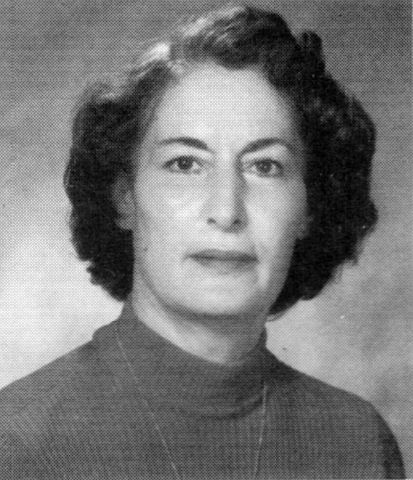
"Melba Tucker"
("In Memoriam: Melba Tucker,"
Bonsai Journal, ABS, Fall 1999, pg. 113; "'A Happening At Davis' -- The All-Star Cast,"
Bonsai Journal, ABS, Winter 1979, pg. 82) SEE ALSO: Aug 22
(ABS Bonsai Journal, Winter 1979, pg. 82) |
| 27 |
1975 -- Toshiji Yoshimura, a leader in both the bonsai and suiseki worlds and the owner of
the Meguro Kofu-en Bonsai Nursery in southwestern Tokyo, died at age 83. (His mother had enjoyed taking
care of the field and plants and potted plants -- at the time the word "bonsai" was only used among specialists
and not yet generally employed. She told Toshiji when he was seven that everyone was attracted to foreign
products, but potted plants were something that would strikingly surprise the foreign countries. He was
already collecting and making bonkei, miniature landscapes made with real or artificial plants and rocks,
all contained in a shallow container. A bonsai dealer who worked with their garden happened to see and
buy a bonkei which Toshiji had made. He realized the truth in what his mother had said, that the more
one studies art, the better the results will be. So he continued to collect potted plants and in the
evenings would stroll the bonsai booths
at
fairs held on the streets. (At about age 14 (c.1905) Toshiji became an apprentice at Yonekichi "Beio" Kibe's Taiko-en nursery, and continued receiving strict training and discipline until Beio died in 1920. Kibe (b.1853), was one of the founders of modern bonsai. He was known to have made wooden models of containers, which models would then be sent through Bansui-ken, a famous dealer in Tokyo, to China for production as a ceramic. Kibe Yonekichi wrote Bonsai Baiyo Ho (Cultivation Methods for Bonsai), published by Sangin Suisekien in 1903. At the International Exposition, St. Louis in 1904 Kibe had on display a Yamato cedar, Hyakunichiko (aka Japanese parsley, a trefoil-shaped herb from eastern Asia), a Pine, and a Cedar. Now, the earliest Nanban containers entered the bonsai scene before the Meiji period and were typically small, round, trough-shaped pots, dishes and jar lids, which were modified into a bonsai pot by drilling holes in their bottom. These were produced in Taiwan, Ryukyuan Islands, Luzon, and Southern China. The age of Nanban pots is generally not essential. They are primarily admired and valued for their rustic grace and charm. At some point in the past, an anonymous bonsai aesthete realised that these qualities would complement bonsai. Soon after that however, Nanban containers became quite popular, while they were rather rare. Yonekichi Kibe had been the lead driver of interest in Nanban till the late Meiji period. In response to this popularity, Chinese merchants set up a production of containers imitating the Nanban shape and appearance. They were mostly produced in Xiamen, Fujian from where they were shipped to Japan via Shanghai. This supply of Nanban containers to Japan continued throughout the pre-war period until 1941. Kibe was the first to use copper wire for shaping and was considered "second to none" by a source from around 1934. (Toshiji also must have learned techniques from well-known bonsai enthusiasts who were customers of Taiko-en. He worked for four more years under Hanjiro Kibe, Beio's son-in-law and successor. Then Toshiji established his own garden, Meguro Kofu-en. By this time his name was well-known, namely for his skills exhibited when he served as the caretaker of the displays at Shotenchi-kai. Shotenchi-kai, mainly organized by the seniors of Keio University and members of the social club Kojunsha, was led for a while by Beio of Taiko-en and was a gathering of leading people in society including politicians and businessmen who were bonsai and suiseki enthusiasts. They met once a month at the popular Kōyō-kan "Maple Club" restaurant on the west corner of Shiba Park (a little ways south of the Imperial Palace), and these gatherings continued from mid-Meiji times until the 1923 Great Kanto Earthquake. The meetings were then restarted sometime afterwards and continued until the late 1930s. The ordinary members of Shotenchi-kai were those who owned bonsai and suiseki and displayed them at the gatherings. Associate members did not have these, but still attended every time. Bonsai was thus held in high esteem by these movers and shakers of Japan. Calm and serene, with confidence and determination, Toshiji Yoshimura was well-respected in the group and made it flourish.) 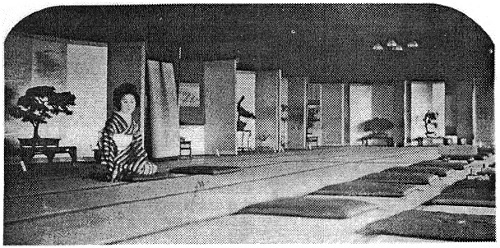
"A photograph from the 5th edition, No. 12 of the magazine 'Bonsai.'
(He was recognized by his own customers for his outstanding skills and
character. He applied the preference of the customers', who were bonsai enthusiasts, into the style of the
bonsai, rather than stressing his own style. His Kofu-en usually then held two or three displays at the
Kokufu-ten bonsai exhibitions during the 1930s, although, according to exhibition
records, there were times that the Yoshimuras, including his younger brother's garden, Koka-en, held seven or
eight displays there. Toshiji was one of the first to start making creative rock-planting bonsai and
often displayed rock-plantings at the Kokufu-ten. Along with Keiji Murata of Koju-en and Itsuzo Okamura
of Ichiraku-en, he established the Nippon Suiseki Association
in 1961.)It shows a display at the Shotenchi-kai held at Koyo-kan in Shiba Park in 1925. The display uses a golden fan-style hanso style. The organizers were Aso, Uematsu, and Murakami. There were more than 10 attendees, including Kitagawa, Yamana, and Chubachi." (Kinbon magazine, October 2011, pg. 45) [Toshiji's son Kinichi would succeed him in running Meguro Kofu-en. Toshiji's most famous child was Yuji Yoshimura.] 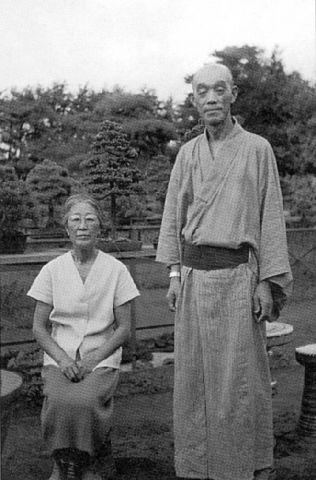
"Fumi and Toshiji Yoshimura [Yuji's parents]
(Personal e-mail from William N. Valavanis to RJB on Feb. 12, 2006; "A Talk on Masterpiece Bonsai and
Master Artists, No. 16 - Toshiji Yoshimura (1891-1975) - Kofu-en," Kinbon magazine, October 2011,
pp. 44-47, English translation kindly provided to RJB in personal e-mails from WNV on 12 and 13 Nov
2011, the latter including comments from Toshiji's grand-daughter, Emi, who helped with the translation;
Japan, The Official Guide, Board of Tourist Industry, Japanese Government Railways, 1941 Revised
& Enlarged Edition, pp. 260, 264-265; Bonsai Masterpieces, Eng. pg. 13, which
gives the date of "about 1870" when a wooden model was made. Kibe would have been 17 or 18 years
old then; The Exhibition of the Empire of Japan, Official Catalogue, 1903,
http://www.archive.org/stream/exhibitionempir00japagoog/exhibitionempir00japagoog_djvu.txt,
pg. 223; "Nanban bonsai pots")
SEE ALSO: Sep 1, Dec 11, Dec Also.
in their Kofu-En Bonsai Garden in July 1961." (Photo by Yuji Yoshimura) (International Bonsai, 1998/No. 1, pg. 30) |
| 28 | 2024 -- Asian Bonsai Master Yong Yap Chong died in his hometown of Kluang, Johar, Malaysia after being in the ICU at the local hospital for a couple of days. (Born in 1964, Yong Yap Chong attended Sekolah Menengah Kebangsaan Sultan Abdul Jalil Shah, a national secondary school located in Seberang Perak in the northeastern part of Kluang. He went on to study Sociology at the University. He then worked at Yi Li Nursery Sdn Bhd, the workshop of the sculptor Geninho, the Touch of Clay pottery kiln in Kuala Lumpur, and Bonsai Leandro. Yong Yap Chong started his Facebook page in November 2010 and had 12K followers by the time of his death. The page has some 38 short reels also of his work and life. One of the best bonsai artists in Malaysia, he had been an apprentice to Cheng Cheng Kung from Taiwan. A video tour of Yong Yap Chong's garden was made in 2018. "How to Make 3-D Space" video was posted by Bonsaï Club Algérie December 19, 2018. This was what he was most famous for. He specialized in Wrightia religiosa (water jasmine) and Juniper bonsai with his fantastic 3-D composition in design and he was well-known for his extreme "surgery" technique on bending large branches and trunks of Wrightia. He had his own bonsai nurseries and traveled intensively throughout Malaysia, in Singapore, Vietnam and Indonesia doing bonsai for important collectors. His creations won many prestigious awards. He was Past President of Johor Bonsai & Suiseki Association, Judging Board Member of Malaysia Bonsai & Suiseki Association, and Technical Advisor for Perak Bonsai & Suiseki Association. Two notable demonstrations Yong Yap Chong participated in were Robert Stevens' International Bonsai Art & Culture Biennial 2014 that October in Yogyakarta, Indonesia with twelve demonstrators from ten countries for people from twenty-one countries and IBA2020 in Jakarta, Indonesia in September, 2020 among over 30 artists from 14 countries seen by over 300 participants from more than 25 countries. This teacher will be missed for his wildness Bonsai creation and the 3D branching concept that makes Malaysia proud of him forever... Please see Thomas Yuan's tribute video to him which includes the funeral.) (Yong Yap Chong's Facebook page, accessed December 1, 2024 by RJB ; Malaysia Bonsai & Suiseki Society's FB post November 29, 2024 by Yoga Singodiwongso ; Robert Steven FB post April 23, 2020 in World Bonsai Artists Community ; "International Bonsai Art & Culture Biennial 2014, Part II," October 21, 2014 by Bill Valavanis ; KELAB SENIMAN BONSAI MALAYSIA (KSBM) FB post January 21, 2020 by Robert Steven ; Robert Steven's FB post August 26, 2024 ; Malaysia Bonsai & Suiseki Society's FB post, August 28, 2024.) SEE ALSO: Jun 25, Dec 31 |
| 29 |
|
| 30 |
|
| 31 |
1932 -- Max Candy was born in Sydney, Australia. [He would go on to become a
major figure in bonsai Down Under, specializing in Ficus specimens.]
(Postings in AusBonsai.com by Grant Bowie, 14 Mar 2010 and
23 Mar 2010; personal e-mail to RJB from Betty Candy 11 Sep 2011)
SEE ALSO: Dec 16
1973 -- The San Antonio Bonsai Society's organizational meeting took place with seven prospective members in attendance. [Its first opportunity to present its talent would come during the San Antonio Garden Center's Spring Flower Show. The Bonsai members' efforts would be awarded several blue ribbons and the Society would win the Sweepstakes Award in Horticulture. By the end of its first club year, the Society's success would be reflected in a membership of 41 motivated enthusiasts. In 1988 the Society would incorporate and host the BCI 24th Annual International Bonsai Congress. In 1996 it would host the Lone Star Bonsai Federation Annual Convention.] ("San Antonio Bonsai Society, Inc. Purpose and History," http://shimagata.tripod.com/sabs/purpose.htm) 2019 -- Solita "Soli" Rosade passed away suddenly this evening in their New Hope, PA home with husband Chase at her side. (Solita D. Tafur, originally from Cali, Colombia, was a widow who founded the Latin American Bonsai Federation, was its first President, and then married American teacher F. Chase Rosade. Both would run monthly, all-day bonsai workshops at home and teach at international gatherings of devotees. She was the Bonsai Clubs International 2nd V.P. 1995-96, 1st V.P. 1997-98, and President 1998-2000. She (sometimes with Chase) demonstrated at the 2000 Carolina Expo in North Carolina, 2001 Bonsai Clubs International Symposium cruise to the Bahamas and then 4th World Bonsai Convention in Germany, 2003 BCI Symposium in New York state and then joint American Bonsai Society-Pacific Northwest Bonsai Association Convention in Washington state, 2005 5th World Bonsai Convention in Washington, D.C., 2006 BCI World Penjing and Shangshi Fair in China, and 2010 FELAB Congress in Mexico while she was Chairman of the World Bonsai Friendship Federation). Solita was the recent past president of the North American Bonsai Federation. She was considered the Grand Dame of Bonsai and was a genuinely interested friend to many teachers and other enthusiasts.) See also this FELAB Memorial. 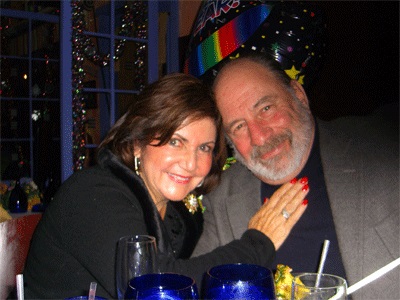
Solita and Chase Rosade, 12/31/05
(Facebook Message from Alejandro Bedini G. to RJB 09/01/19 am, soon followed by numerous posts
on FB to the general public, including ones by Karen Harkaway, Sanjay Dham, and Randy Clark; The Indices BCI,
pp. 40-42.) SEE ALSO: Jan 30, Oct 19, Nov 20
(Photo courtesy of Alan Walker, 05/11/07) |