|
This Page Last Updated: July 09, 2026 |
|
Dangozaka is a hill in Tokyo's Bunkyo City that slopes downwards to the east between the Sendagi
2-chome and Sendagi 3-chome neighborhoods. It is just northwest of Ueno. There are two explanations
as to how the hill got the name Dangozaka ("Dumpling Hill"). One explanation is that there used to be
a dumpling shop at the bottom of the hill; the other is that people who slipped while walking down the hill
in the rain when it was slippery used to roll down the slope like dumplings. Dangozaka has been featured
in many literary works, including "Ukigumo" by Futabatei
Shimei and "D-zaka no Satsujin Jiken" by Edogawa Ranpo.
Several famous people lived in the area at the top of the hill, including novelist and poet
Natsume Soseki, poet and sculptor
Kotaro Takamura, and general and novelist
Mori Ogai (pen name of Mori Rintaro, whose work "Seinan"
also featured Dangozaka). The road at the bottom of the hill continues onwards towards the Yanaka district,
Taito City, Tokyo. 1 In terms of gardening for pleasure in Edo [their quickly growing secular capital town/city, the first three Tokugawa Shoguns (r. 1603-1651) got the ball rolling and were increasingly fond of plants with each generation...] With the ruling family so enamoured of gardening, many daimyo (feudal lords) felt that it would be prudent to follow suit. Their estates in Edo were soon transformed into veritable farms, with vegetables and medicinal plants grown alongside ornamental plants and flowers. Not only did the daimyo present flowers to the Tokugawa family as gifts, the ruling family also bestowed gifts of potted plants and seedlings upon their retainers. Allowing these plants to die would have caused great offense to the shogun, which added considerably to the burden of those tasked with keeping them alive. (The Great Fire of Meireki in 1657 caused a restart in the building of the de facto capital city.) Next to catch the gardening bug were the lower-ranked samurai, followed by the wealthy merchant class, until eventually even the lowliest working-class tenement houses in Edo's cramped back alleys had rows of potted plants lined up on the street under the eaves. The sight and sound of plant and flower vendors, their baskets of wares balanced on poles over their shoulders, became commonplace across the city. The pursuit of gardening as a hobby in samurai society was not limited just to Edo. The sankin-kotai system, which sought to control the daimyo by requiring them to reside in Edo in alternate years, had the effect of spreading Edo's gardening culture throughout the country as the daimyo took the habit back with them to the provinces. As the gardening craze spread, enthusiasts became increasingly focused on botanical novelties such as plants with unusual flowers and colour variegations, or dwarf varieties and trees with twisting growth habits. This passion for the unusual prompted rapid advances in propagation techniques such as grafting, root division and the taking of cuttings, as well as selective breeding...2 From about 1688 to 1703, a major passion in Edo for potted momiji (type of Japanese maple, Acer palmatum) resulted in an extraordinary number of new varieties (many well-known of today were first grown then). Interest in azaleas and camellias also rose from this time, followed by a succession of vogues for individual flowering plants and trees. By the end of the 17th century -- the Genroku Period -- when distinctly urban culture was taking shape, dwarf potted trees had become even more popular in Edo. It was just as much a part of the city's fabric as the tea ceremony, wood block prints, or the bunraku puppet theatre. The dwarfed potted trees became a part of the culture through the Noh play "Hachi no ki" which dramatized an actual early grower's story in the context of history. In fact, potted tree craze was so pronounced that it would later be likened to the Dutch "tulip mania" happening on the other side of the world at roughly the same time, with dwarf tree specimens bought and sold for fantastic prices "according to the number of buds growing on them." 3 (From about 1772 to 1801, there was fashion for tachibana (mandarin orange) dwarf potted trees in Osaka. From about 1781 to 1788, a show for traditional dwarf potted pines was begun to be held every year in Kyoto. Connoisseurs from five provinces and the neighboring areas would bring one or two plants each to the show in order to submit them to visitors for ranking. Perhaps in a future article we will similarly explore the development of this art in those two other major Japanese cities.) 4 These new discoveries in plant breeding were accompanied by a flurry of publications, from simple illustrated growers manuals, to treatises on plant classification, and exquisitely illustrated reference books. The demand for such publications was strong, continuing unabated through the political unrest of the final years of the Edo period and the eventual overthrow of the shogunate government. Gardening in Edo became a competitive endeavour. Plant aficionados gathered in public to enter their blooms in the ever-popular flower shows and competitions, and a ranking system similar to that used in sumo wrestling was even established. The gardening world of old Edo was extraordinarily egalitarian, with no class or social barriers to participation in competitions, and entries judged solely on the basis of their merits. 2 Now, in 1635, the Japanese [Tokugawa shogunate had] moved to completely secure their borders and instituted the policy known as sakoku (seclusion). Only Koreans, Chinese and a few Dutchmen per year would be allowed to enter Japan through the port of Nagasaki. Though not totally isolated, Japan turned inward for more than two centuries. In the 19th century, sakoku became increasingly difficult to enforce as the Europeans (and Americans) began to industrialize. When sakoku was instituted, Japanese technology was roughly on par with the rest of the world. And though Japan developed internally under the Tokugawa and the early stages of industrialization were evident, it became clear by the middle of the 19th century that Japan was behind. When an American naval squadron of four ships commanded by Commodore Matthew Perry appeared off the coast of Izu Peninsula [to the southwest of Edo] in 1853 and demanded that the Japanese open their country, they had little choice but to comply. Over the next fifteen years, the Tokugawa were forced to sign multiple, humiliating treaties, and foreigners started living in the country who were not bound by Japanese law and were ignorant of Japanese culture and society. During this time, the government demonstrated that it was unable to defend its borders and to keep the country safe from a potential (or real) barbarian invasion. 5 Farmland had been opened up in Komagome Village since before the Edo period began, and areas of samurai residences, Imperial land, temples and shrines, and townspeople areas developed during urban expansion in the Edo period. 6 During the mid to late 1700s, garden shops in the Edo neighbourhoods of Sugamo and Komagome began printing pamphlets to advertise their businesses. Plant nurseries became leisure time destinations much like today's shopping malls, and had all the hustle and bustle of trade fairs. (Did any of the nurseries ever use woodblock prints that contained images of dwarf potted trees to attract attention to their wares?) Common people who had no space for gardens of their own could still enjoy hanami (flower viewing excursions). Guidebooks featuring Edo's best locations to appreciate the beauty of nature and gardens had something for every season, from early spring plum blossoms to autumn leaves. 2 Looking at the trends of urbanization in the Komagome area, in response to the demand from large Edo period urban areas on suburban agricultural areas, it was confirmed that the commercialization of agricultural production in the form of "horticulture," was further incorporated into the culture of Edo's upper classes. This suggests that suburban farmland played a very important role in Edo era development. Horticultural agriculture also developed in the Komagome area in the northern suburbs of Edo, where, on the northern edge, Somei was famous for its plum groves and cherry blossoms. Same at Sendagi-cho, chrysanthemum viewing, flourished in drawings from the Edo period, and there are many descriptions of "gardeners' residences." 4 The scale of the Edo Period gardening craze, which extended from the lofty ruling classes to the lowliest commoners, was unparalleled anywhere else in the world. When the first visitors from the West began to arrive after 1853, they were amazed at what they saw. Scottish plant collector Robert Fortune (see below), who visited Edo in the 1860s, was struck by the number and variety of potted plants he saw lined up on the streets outside people's houses all over the city. Reflecting on the state of his own country, he commented that if a love of plants could measure the level of a civilisation, then Japan's would be far superior!" 2 By 1829, tako-tsuki (octopus-shaped) trees by being offered by a grower in Asakusa Park, an Edo suburb. (Within 20 years the neighborhood would be crowded with nurseries selling dwarf potted trees. By that time flower markets and exhibitions would also have been taking place there, and would continue at least through the 1910s. There were eventually developed specialised dwarf potted tree nurseries which produced the mainly requested species, pine and ume (flowering apricot). Their merchandise were not pieces of art but nursery stock produced according to certain standards and rules for their design according to the ideals of a certain school, a highly appreciated characteristic implying a certain degree of perfectionism but still subject to fashions. They left almost no creative freedom to the designer. Thus, dwarf potted trees strictly as a tradition or symbol, the religious/mythical approach was starting to be replaced as the principle feature by the design/craft approach. 7 In 1833, the three-volume Kin seiju fu betsuroku (Album of Long Lived Plants) was published in Edo. By Choseisha Aruji (aka Choseisha Shujin), this was possibly the first catalog of dwarf potted trees, tools, and pots. Profusely illustrated and identifying many varieties of trees, it showed the method of nurturing, side or cleft grafting, and care of potted trees. It had explanations as to rooting methods and the tools necessary. Bright containers and ceramics of various shapes and depths were shown. 8 "Su-mae-yah" refers to the historic Somei village gardens where each family managed its own nursery. It was renowned for its extensive nursery gardens, variegated plants, and specialized, dwarf plants. It was a center for horticultural innovation during the Edo period. Edo gardeners were mostly living in suburbs such as Honjo, Shitaya, and Somei (areas currently known as Sumida-ku, Taito-ku, and Toshima-ku respectively). They obtained large pieces of land and began to practice horticulture. Around the mid-19th century, almost 80% of the land of the town of Edo was occupied with samurai estates and temples alone. There were gardens of various sizes, so it seems that it had become a gorgeous garden city with an estimated population of about 1.15 million. The gardener was a big success there. In particular, Sendagi, Komagome, Somei, and Sugamo seem to have been home to wealthy gardeners. In the social record Takee Chronology at that time, there is a description that an old family named Uekiya Uheiji would open Shisen-tei Baien on Sendagi Shichimenzaka on February 19, 1852. 9 The Shinsentei (Purple Fountain Pavilion) was described on an 1852 Kiriezu map as a shiki hanayashiki or "flower pavilion for all four seasons" and covered an area of two and a half acres. 10 Four years later in May 1856, the artist Utagawa or Andō Hiroshige (1797-1858) published a woodblock print Sendagi Dangozaka Flower House, No. 16 in his series the "One Hundred Famous Views of Edo." Sendagi 2-chome, Bunkyo Ward, is part of the Yanesen area, a charming, quaint little town in the north-eastern district of Tokyo. Its name is actually an amalgamation of three different neighborhoods that make up the entire Yanesen town: Yanaka, Nezu, and Sendagi. The garden partially shown was designed only four years earlier by the gardener Kusuda Uheiji. The work depicts the bustling teahouses and flower houses that gave Dangozaka its name, making it an essential work for understanding the leisure culture of the Edo commoners. This piece is popular for its vivid portrayal of Edo's downtown atmosphere and leisure culture. (The 1855 Edo earthquake and subsequent fires in the region the previous November apparently did not cause damage to this particular area.) 11 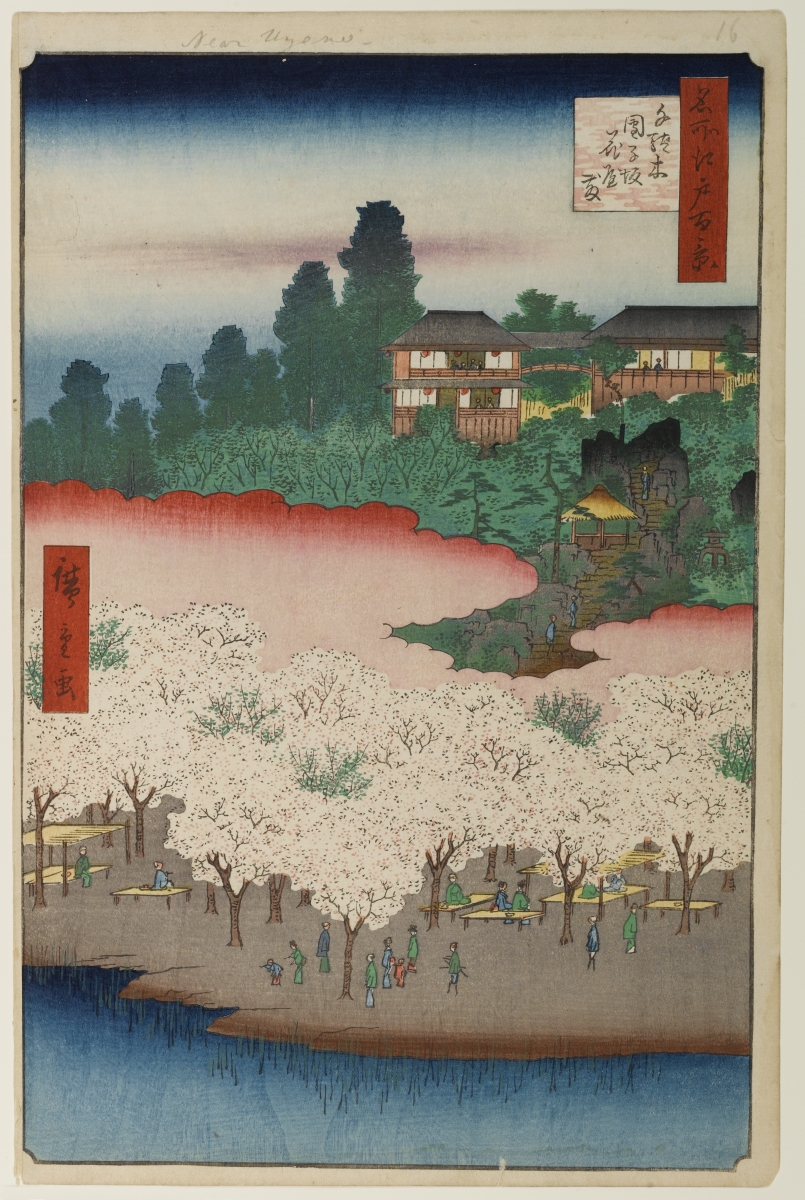
During the Edo period, the area was lined with many teahouses and known for serving their specialty, dango (rice dumplings). It was always a bustling place. The area around the slope was home to flower gardens and restaurants, known as Hanayashiki. The gardens, where visitors could enjoy seasonal flowers such as plum, cherry, and peonies, were truly a "little paradise" for the common people of Edo. Sendagi is close to Ueno and Yanaka, and is home to many temples and shrines, so it was located on walking routes. As such, it was a perfect stop for sightseeing visitors and it was common to enjoy a combination of pilgrimages and cherry blossom viewing. Cultural enjoyment was also popular, with people composing haiku while enjoying rice dumplings at a teahouse or painting pictures with flowers as the subject. The center of the painting depicts people walking up and down the slope. The painting vividly depicts a scene from everyday Edo life, with townspeople shopping, leisure travelers admiring the flowers, and children eating dango (rice dumplings). The teahouse that gave Dango-zaka its name served its famous dumplings. For the common people of Edo, dipping fragrantly roasted dumplings in a sweet and spicy sauce and enjoying the view was the ultimate luxury. In the background, the flowers blooming in the gardens of the Hanayashiki add a touch of color. Hiroshige's skillful expressiveness is on full display in his depiction of the changing seasons, with cherry blossoms in spring and irises and peonies in early summer. From the top of the hill, the Edo townscape spreads out in the distance, and the sky offers a sense of expansiveness. The composition, which combines the entertainment of the common people with the scenery of the great city of Edo, is the allure unique to paintings of famous places. The picture plane is divided into upper and lower halves by clouds. Dangozaka is located off-screen to the right, and would descend from back to front at a slope similar to the stairs in the painting. Instead, the upper part of the image shows Shisentei, the flower garden of former gardener Kusuda Uheiji, located south of the slope. Shisentei was an unusual three-story building which was popularly known as the "Outlook" (Miharashi) for its views of Ueno and Shinobazu Pond. It seems that people could also bathe inside. 12 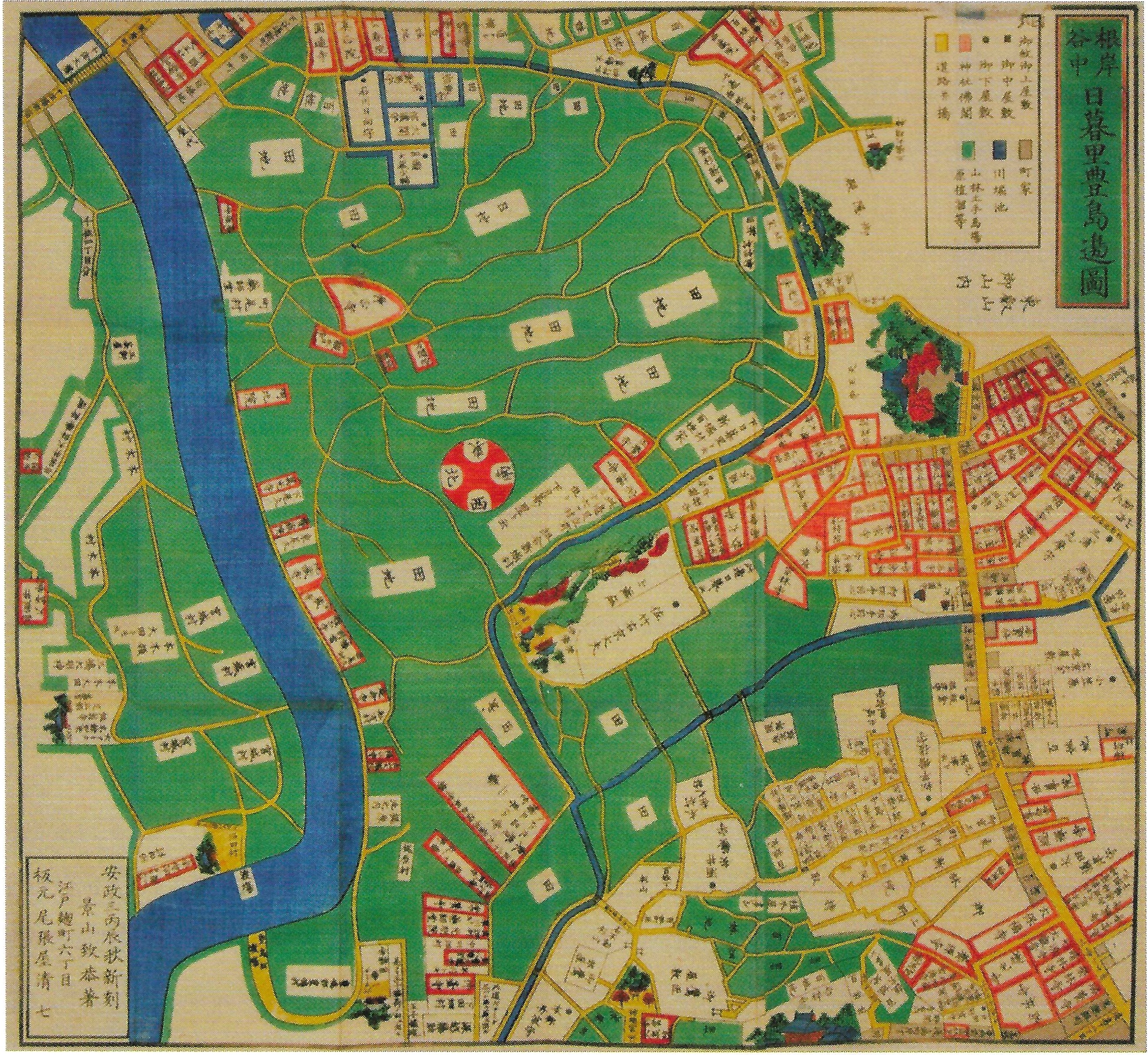
Negishi Yanaka Nippori Toshima Hen Ezu Maps of the Negishi, Yanaka, Nippori and Toshima Areas, 1856 (from The Birth of Omiya Bonsai Village, pg. 3) 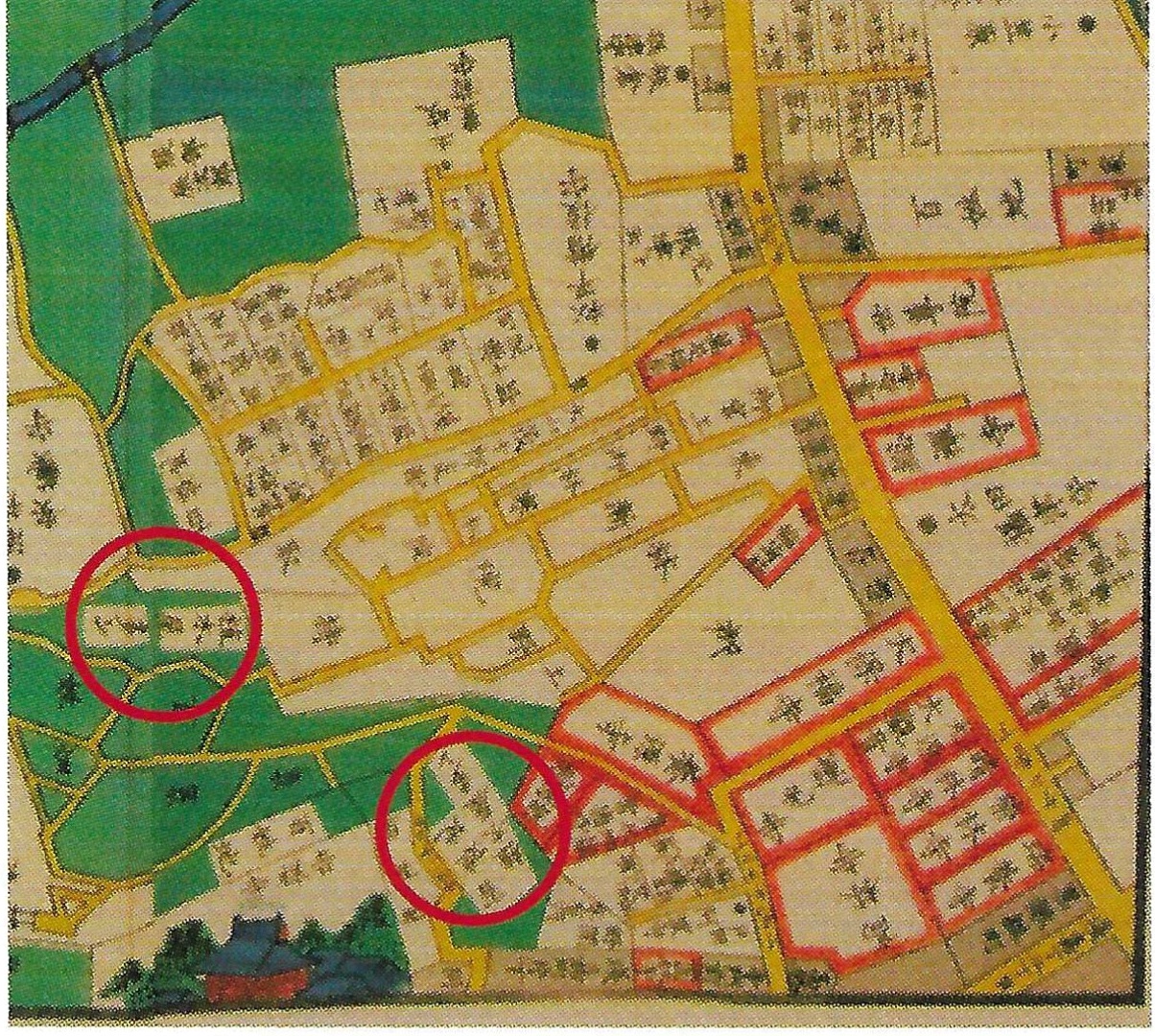
Enlarged area (lower right hand corner) around Dangozaka Street, 1856 The words "Many nursery stores are here" written in the area circled in red. (from The Birth of Omiya Bonsai Village, pg. 3) 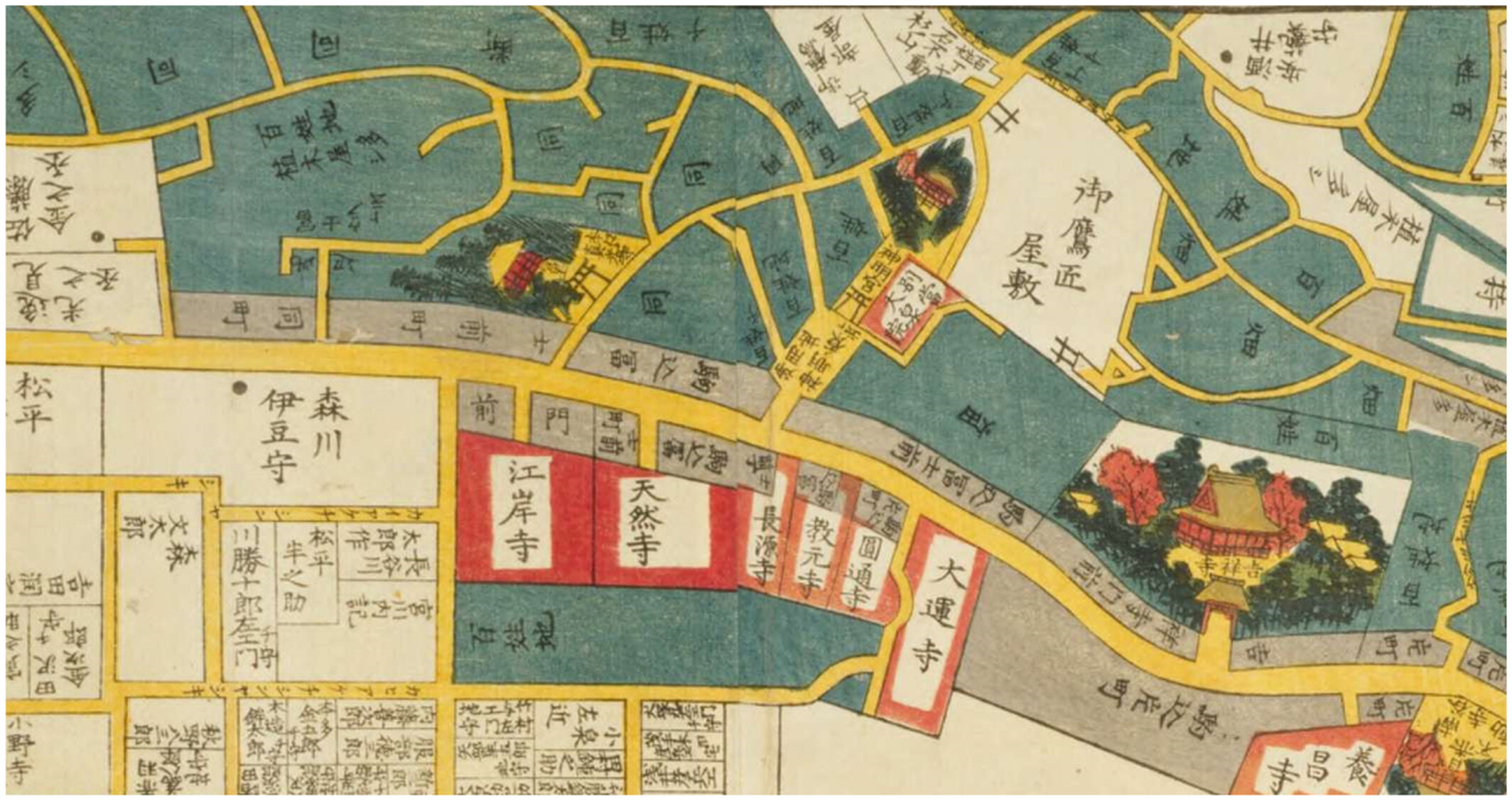
Detail of Komagome pictorial map, original date of publication Kaei 7 (1854), date of revision
Ansei 4 (1857), published by Owariya Seishichi for Tomatsu Masanori. (from "Gardeners' farmland in Komagome as seen in the 'Ansei period Komagome Fuji shrine area map and illustration," Figure 4; publication data from here. Larger map with more residential areas can be found here.) Robert Fortune (1812-1880) was a Scotsman who gained an appointment as a Botanical Collector to the Horticultural Society of London. He was in China the first time in 1843, then returned in 1848, 1853, and 1862 with a visit to Japan twice during 1860-1862. His four travel books were enormously popular, went through several editions, and made him the most famous British traveler in the China of his time. Many excerpts of Fortune's works appeared in various newspaper and magazine articles. He is said to have introduced over 120 new types of plants to the West, and established the cultivation of tea in India for the British. In 1858 he was employed by the American government to explore China for tea plants which would grow in the Southern States. From his 1863 book Yedo and Peking we read: "The capital of Japan is remarkable for the large number of gardens in its suburbs where plants are cultivated for sale. The good people of Yedo, like all highly civilized nations, are fond of flowers, and hence the demand for them is very great. The finest and most extensive of these gardens are situated in the north-eastern suburbs, at places called Dang-o-zaka, Ogee, and Su-mae-yah. As one of my chief objects in coming to Yedo was to examine such places as these, I lost no time in paying them a visit. "As the British Legation was situated in the south-west suburb, I had to cross the entire city before I could reach these gardens...about 9 or 10 miles... "...After passing the residence of Prince Kanga [said to be the richest man in the Empire,] I found myself in the eastern suburb. One long street, with houses on each side of the way, and detached towns here and there, extended two or three miles beyond this. Turning out of this street to the right hand, I passed through some pretty shaded lanes, and in a few minutes more reached the romantic town of Dang-o-zaka. This pretty place is situated in a valley, having wooded hills on either side, with gardens, fish-ponds, and tea-houses in the glen and on the sides of the hills. In the principal tea-gardens the fish-ponds are stocked with different kinds of fish; and I observed a number of anglers amusing themselves fishing, in the usual way, with hooks baited with worms. "The most curious objects in this garden were imitation ladies made up out of the flowers of the chrysanthemum. [See below] Thousands of flowers were used for this purpose; and as these artificial beauties smiled upon the visitors out of the little alcoves and summer houses, the effect was oftentimes rather startling. The favourite flowering plum-trees were planted in groups and avenues in all parts of the garden, while little lakes and islands of rockwork added to the general effect. "Having patronised this establishment by taking sundry cups of tea, I intimated to my attendant yakoneens my intention to look out for some gardens of a different kind, in which I could purchase some new plants. But pleasure was the order of the day with them, and they coolly informed me there were no other places worth seeing here, and that we had better go on to the tea-gardens of Ogee... "The day was far spent before I had finished the inspection of these interesting gardens, but I was greatly pleased with the results. A great number of new shrubs and trees, many of them probably well suited for our English climate, had been purchased. Orders were now given to the different nurserymen to bring the plants to the English Legation on the following day, and we parted mutually pleased with our bargains. It was now too late to go to Ogee or Su-mae-yah, so that journey was put off until another day. "Mounting our horses, we left the pleasant and romantic lanes of Dang-o-zaka and rode homewards. In coming out we had passed to the south of the Tycoon's palace, but in going home a different route was taken -- a route which led us along the north side of these buildings... "[The great city was at last left behind.] Park-like scenery, trees and gardens, neatly-clipped hedges, succeeded each other; and my attendant yakoneens [who accompanied me on all my excursions to prevent the chance of an attack from any one who had seen us going out] at length announced that we had arrived at the village of Su-mae-yah. The whole country here is covered with nursery-gardens. One straight road, more than a mile in length, is lined with them. I have never seen, in any part of the world, such a large number of plants cultivated for sale. Each nursery covers three or four acres of land, is nicely kept, and contains thousands of plants, both in pots and in the open ground. As these nurseries are generally much alike in their features, a description of one will give a good idea of them all. "On entering the gateway there is a pretty little winding path leading up to the proprietor's house, which is usually situated near the centre of the garden. On each side of this walk are planted specimens of the hardy ornamental trees and shrubs of the country, many of which are dwarfed or clipped into round table forms [sic]. The beautiful little yew (Taxus cuspidata) which I formerly introduced into Europe from China, occupies a prominent place amongst dwarf shrubs. Then there are the different species of Pines, Thujas, Retinosporas, and the beautiful Sciadopitys verticillata, all duly represented. "Plants cultivated in pots are usually kept near the house of the nurseryman, or enclosed with a fence of bamboo-work. These are cultivated and arranged much in the same way as we do such things at home. The Japanese gardener has not yet brought glass-houses to his aid for the protection and cultivation of tender plants. Instead of this he uses sheds and rooms fitted with shelves, into which all the tender things are huddled together for shelter during the cold months of winter. Here I observed some South American plants, such as cacti, aloes, &c., which have found their way here, although as yet unknown in China -- a fact which shows the enterprise of the Japanese in a favourable light. A pretty species of fuchsia was also observed amongst the other foreigners. In one garden I saw a large number of species of acorus with deep green leaves. These were cultivated in fine square porcelain pots, and in each pot was a little rock of agate, crystal, or other rare stone, many of these representing the famous Fusi-yama, or "Matchless Mountain" of Japan. All of this little arrangement was shaded from bright sunshine and protected from storms by means of a matting which was stretched overhead. There was nothing else in this garden but the acorus above mentioned, but of this there must have been several hundred specimens. The pretty Nanking square porcelain pots, the masses of deep green foliage, and the quaint form and colouring of the little rocks, produced a novel and striking effect, which one does not meet with every day... [The Dutch East India Company's] President Meylan, in the year 1826, saw a box which he describes as only one inch square by three inches high, in which were actually growing and thriving a bamboo, a fir, and a plum-tree, the latter being in full blossom. The price of this portable grove was 1200 Dutch gulden, or about £100. In the gardens of Su-mae-yah dwarf plants were fairly represented, although I did not meet with anything so very small and very expensive as that above mentioned. Pines, junipers, thujas, bamboos, cherry and plum trees, are generally the plants chosen for the purpose of dwarfing. "The art of dwarfing trees, as commonly practiced both in China and Japan, is in reality very simple and easily understood. It is based upon one of the commonest principles of vegetable physiology. Anything which has a tendency to check or retard the flow of the sap in trees, also prevents, to a certain extent, the formation of wood and leaves. This may be done by grafting, by confining the roots in a small space, by withholding water, by bending the branches, and in a hundred other ways, which all proceed upon the same principle. This principle is perfectly understood by the Japanese, and they take advantage of it to make nature subservient to this particular whim of theirs. They are said to select the smallest seeds from the smallest plants, which I think is not at all unlikely. I have frequently seen Chinese gardeners selecting suckers for this purpose from the plants of their gardens. Stunted varieties were generally chosen, particularly if they had the side branches opposite or regular, for much depends upon this; a one-sided dwarf-tree is of no value in the eyes of the Chinese or Japanese. The main stem was then, in most cases, twisted in a zigzag form, which process checked the flow of the sap, and at the same time encouraged the production of side-branches at those parts of the stem where they were most desired. The pots in which they were planted were narrow and shallow, so that they held but a small quantity of soil compared with the wants of the plants, and no more water was given than was actually necessary to keep them alive. When new branches were in the act of formation they were tied down and twisted in various ways; the points of the leaders and strong-growing ones were generally nipped out, and every means were [sic] taken to discourage the production of young shoots possessing any degree of vigour. Nature generally struggles against this treatment for a while, until her powers seem to be in a great measure exhausted, when she quietly yields to the power of Art. The artist, however, must be ever on the watch; for should the roots of his plants get through the pots into the ground, or happen to receive a liberal supply of moisture, or should the young shoots be allowed to grow in their natural position for a time, the vigour of the plant, which has so long been lost, will be restored, and the fairest specimens of Oriental dwarfing destroyed. It is a curious fact that when plants, from any cause, become stunted or unhealthy, they almost invariably produce flowers and fruit, and thus endeavor to propagate and perpetuate their kind. This principle is of great value in dwarfing trees. Flowering trees -- such, for example, as peaches and plums -- produce their blossoms most profusely under the treatment I have described; and as they expend their energies in this way, they have little inclination to make vigorous growth. "The most remarkable feature in the nurseries of Su-mae-yah and Dang-o-zaka is the large number of plants with variegated leaves. It is only a very few years since our taste in Europe led us to take an interest in and to admire those curious freaks of nature called variegated plants. For anything I know to the contrary, the Japanese have been cultivating this taste for a thousand years [sic] ... "On various occasions during my stay in Yedo I repeated my visits to [those nurseries] and was thus enabled to add to my collections a very large number of the ornamental trees and shrubs of Japan." 13 Francis Hall (1822-1902) was an upstate New York book dealer who went to Japan in 1859 to collect material for a book (his diary would run to nearly 900 pages), and serve as correspondent for Horace Greeley's New York Tribune, which published close to seventy of Hall's articles. Hall probably only intended to stay for one or two years, but successful ventures extended his stay. His book Japan Through American Eyes, the Journal of Francis Hall, Kanagawa and Yokohama 1859-1866, on pg. 430 states: "[Tuesday, June 17, 1862] ...We ride across the city till we come to the Somee [Somei] suburbs noted for their extensive gardens and nurseries and we find these indeed of great extent, for they bordered the road on both sides for at least a mile on one street and half a mile on the other. A very considerable portion of the northernmost suburbs, as we found by this and other excursions, is devoted to growing trees and plants for sale. We dismount and visit several of these gardens. They are quite unlike the Chinese gardens such as the Fati or Pontinqua gardens at Canton, there is an absence of that grotesque gardening which delights in all sorts of fantastic shapes. The Japanese gardener, though he is fond of training his tree to look like a boat or an elephant, is more fond of imitating objects of more grace and more in harmony with plant life. In the gardens of Somee we see very little of the fantastic gardening but a great deal of skillful cultivation and a variety and vigor of growth very interesting. No inconsiderable portion of the trees and plants are of foreign birth, though the love and proper pride of the Japanese gardener, and worthy of imitation in all lands, appears to be to make the most of the best of what is native to the country, so that by far the most interesting portion of all these gardens were the native growths." 14 It has been suggested that with the coming of Westerners and their tastes in plants, the formerly wild-looking dwarf potted trees with extremely distorted shapes popularly made in Japan and based on the older Chinese style were less often purchased at commercial nurseries than those in a pot alone without stones and with a more "natural" albeit more manicured form. The Western interest for Japonisme apparently worked both ways. Demand for a certain type of dwarf tree altered much of what was subsequently grown, shaped, and offered. Large, old, magnificent specimens in more characteristic Japanese styles were still, of course, being grown at some of the older nurseries. 18 Following the rise of horticulture that was supported by the demand for landscaping in the daimyo residences and the popularity of flower viewing among common people in the Edo period, in the Meiji era there was a new trend for chrysanthemum doll houses in the Sendagi area. This reached its peak in the middle of the Meiji era and then went into decline, so that by the end of the era, most gardeners in the area had closed down. (In 1856, a gardener who cultivated chrysanthemum moved to Sendagi from Somei, and the area became known for kiku ningyo, dolls wearing clothing made of chrysanthemums.) In particular, the development of rice paddies and other crop fields into residential land was promoted due to the remarkable urbanization of the outskirts of Edo, which resulted in the loss of the environment for growing plants. For these reasons, there was a new trend to cultivate dwarf potted trees, plants grown in pots starting with seedlings on multiple vertical shelves. 10 Dangozaka of Sendagi became known for its production of kiku-ningyo at the end of the Edo period. When the Meiji Period began in 1868 and Edo was renamed Tokyo ("Eastern Capital"), the number of gardeners began to dwindle due to garden properties being turned into housing lots. The gardeners around the Dangozaka area became popular among politicians and businessmen in exhibiting and selling dwarf potted trees as well as kiku-ningyo. Before long, these gardeners started specializing and creating dwarf potted trees gardens in the general Dangozaka area. 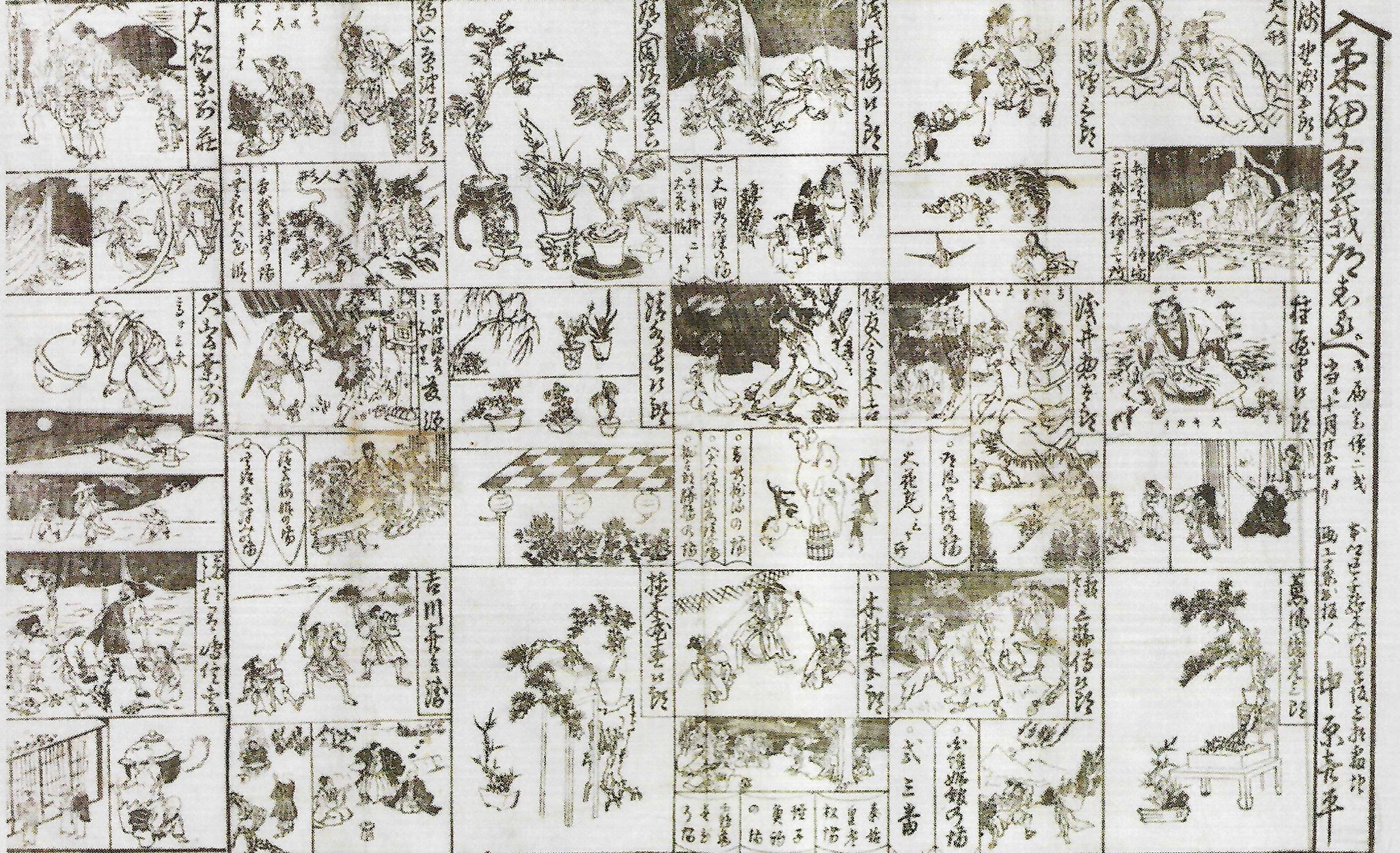
Kiku-Zaiku Bonsai Michishiube (Bonsai Chrysanthemum Flower Art Information Sheet) This Meiji Period list ranks chrysanthemum dolls. On the top row in the third column, it says "Seidai-en Tokichi Shimizu" (from The Birth of Omiya Bonsai Village, pg. 5) Tokichi Shimizu (1841-1905), the first-generation owner of Seidai-en, had been mainly creating kiku-ningyo together with other gardeners of the area since the beginning of the Meiji Period. In Tokyo Hyakuji Bin (Everything about Tokyo, published in 1890), Seidai-en was introduced as a Tokyo garden famous for roses, a pine bonsai tree loved by Shogun Toyotomi Hideyoshi, and a fern treasured by the Korean imperial family.12 [NOTE: Hideyoshi was not a shogun. Could this actually be a reference to Tokogawa Iemitsu who did have a celebrated pine bonsai?] A list advertising The Famous Gardeners of Tokyo, dated October 1886, mentions two hundred and eighty-four gardeners who had a flower shop, a horticultural or a landscaping firm, including a separate category of twenty-six nurseries specializing in root-balled trees. Among these twenty-six there is only one in the Somei village: that of Kawashima Gonbei (1840-1897). It was undoubtedly Gonbei, therefore, who provided colleagues and the wholesale trade with his root-balled "Yoshino," the Tokyo cherry; likely he was also selling directly for projects where he planted trees himself. Kawashima Gonbei has not been forgotten in the Somei village community, although all nurseries have disappeared with modern urban development. Because most cemeteries were attached to Buddhist temples, the Meiji government took over the family cemetery of a minor daimyo family in 1872 to create what was originally a Shinto cemetery, a remnant of which survives today. The Meiji government then passed control of it to Tokyo in 1874 from whence it became a non-sectarian cemetery. Most of the old neighboring nursery land also became part of that Somei Reien (Cemetery) in Komagome in the Toshima Ward of Tokyo. Somei Reinen (the name dates from 1935) is the smallest of the eight cemeteries operated by the city of Tokyo. As might be expected from the name, the Somei Reien has a large number of Somei Yoshino trees as well as other varieties of flowering cherry and plum trees. A section of the old main road of the village remains as one of the major thoroughfares through the fields now packed with graves. Two florists are found today at the entrance of the cemetery, close to this main avenue. One of the shops, established in 1874, is owned by the Konomori family. The late Konomori Shozo had been a locally well-known historian on the Tokyo cherry and had been awarded with a cherry prize. From his reports we learn that the nursery Oko-en, "Cherry Fragrance Garden," had released the Tokyo cherry. The name and fame of Oko-en are clearly established with Gonbei's grandson Kawashima Ginzo (1880-1915), who propagated well over a hundred different named cherries, including 'Yoshino,' and selling them commercially. (These 'Yoshino' cherries had no relation to Yoshino Mountain but had been brought in by gardeners from Somei village.) Unfortunately he was not long-lived, and all his sons died in their twenties, meaning the end of the nursery. A longer-living daughter and a former employee of the nursery formed sources of oral history, while local temple archives mention grandfather Kawashima Gonbei (1840-1897) as a cherry nurseryman. The Yoshino, propagated either by seed or by clone, was famed among specialists from at least the 1820s. Garden lovers in Edo bought their plants not only at nurseries, such as in Somei, but also on an open street market for garden plants, or from vendors who could even carry root-balled cherries around. But this particular cherry in the Koishikawa Botanical Garden [about 3 km north of the Imperial Palace] would have been bought from the Ito family of Somei, as it was the sole official purveyor to the feudal lords. The Ito house was a well-established nursery for many generations, they were well known because of their plant catalogues that had been published in earlier centuries. These advertised a full range of garden plants, so it is obvious that the nursery functioned as a wholesaler, not as grower or breeder. That Ito sold this cherry does not mean that he also procured it; rather, it means that somebody else in Somei had grown it, so the Kawashima family remains firmly in focus. [Some additional background on the Ito family can be found here, from a few minutes of research on MS CoPilot Chat, 06/09/26 a.m..] 17, 18 Ito "Jūbei" Jōtarō (1855-1916) succeeded the 4th generation Jūbei of the gardening profession in Komagome, Tokyo in 1873, and his nursery was Jōshun-en. In 1899 Jōtarō became the mayor of Sugamo-cho. 19 The leading Tokyo gardener of the Seidai-en garden, Tokichi Shimizu, further made a name for himself at the Artistic Bonsai Fair/Concours held in 1892 in Negishi, during which event he played a central role not only as a promoter, but also as a judge. Unfortunately, the names of the other participating individuals are apparently lost to history -- as this was basically a local event and the local nursery and garden owners were "obviously" all there at the Fair -- but the network they formed became the modern bonsai world. Representing the professional nursery class in Tokyo (Negishi with the Ueno / Sendagi / Dangozaka areas), this was the first organized public exhibition of bonsai exhibition held in Tokyo (or even Japan), marking the moment when bonsai was consciously presented and judged as an independent fine art form (bijutsu). The event was followed by the publication of a 3-volume picture book about the Concours, which specifically shows a mountain azalea (satsuki-type) bonsai exhibited by Shounosuke of Oukei-en. Amateur associations then began to be formed. Shimizu would also participate in the 1902 Bonsai Concours, presenting compositions of his making and suiseki (naturally occurring rocks appreciated for their aesthetic value).14, 15 During the Edo period, Negishi was part of Kanasugi Village in Musashi Province's Toshima District, becoming territory of Toeizan Kanei-ji Temple in 1646. The name derives from being located at the base of Ueno's cliffs, where the shoreline once extended like tree roots when the sea reached into the area. (Much of south and eastern Edo was reclaimed land that transformed wetlands and coastal shallows from what we now call Tokyo Bay into new urban districts during the Tokugawa period. When Ieyasu began his Shogunate there was no urban district, no planned streets, and no concentrated population. To the east of the fortified residence that would become the Imperial Palace compound stretched nothing but wetlands, tidal inlets, marshes, and patches of undeveloped wasteland.) During the 1880s, a literary circle known as the Negishi Party formed, centered around Mori Ogai (see top of this page) and others, and attracted others. In 1889, following municipal reforms, land south of the Shakujii aqueduct (Otonashi River) was incorporated into Shitaya Ward, becoming Kami-Negishi, Naka-Negishi, and Shimo-Negishi towns in 1891. From the Edo through Meiji periods, the area around Uguisudani was called "Negishi no Sato" and became a retreat location for wealthy merchants seeking quiet and scenic surroundings.16, 17 Miyagawa (Makuzu) Kozan died in Dangozaka in 1916 at age 74. He came from a long line of potters from Kyoto, and in 1870 moved the business to Yokohama, setting up a workshop there the following year. He took advantage of newly imported Western technology to create novel styles of high-fired, glazed porcelain designed to appeal to the changing tastes of the Western market. He participated in numerous international and major exhibitions in Japan as well, winning countless awards, and he served on a number of societies and associations to further various arts. He moved his kiln to near downtown Tokyo in 1888. One of the greatest potters of the Meiji Era, Kozan was also renowned in certain circles for his bonsai pots, but he sold them under very special conditions. He only made these pots on order, and only if the buyer promised not to keep any bonsai in them. As a result there were very few bonsai pots made by this remarkable potter, and only a very few exist today.23 Ishii Kendo (1874-1946) wrote a commentary in 1919 on Hiroshige's Sendagi Dangozaka Flower House print. By the time Ishii was writing in 1919, however, the original garden had been closed to public viewing and the land sold off into lots for private homes.9 The Dai Nihon Bonsai Shorei Kai (Great Japan Bonsai Promotion Society) had been started by Ritaro Shimizu and other Tokyo gardeners in 1921 and was the only group focused on spreading the influence of bonsai. Near downtown Tokyo was the Kanda ward, to the east of the Imperial Palace and west of the Sumida River. Kanda is where bonsai were grown in the backyards. It was one of the areas gutted by the Great Kantō Earthquake of September 1, 1923 which caused devastating damage to farmland in this area. Three major earthquakes (8.0 plus a 7.2 and then 7.3 aftershock) within about ten minutes hit the region. Four other 7.0+ aftershocks would follow. Damage across Tokyo particularly took place in districts such as Asakusa, Kanda, Nihonbashi, Kyobashi, Honjo, and Fukagawa. Occurring just before noon as all the lunch-time fires were lit in the many restaurants and shops, the earthquake's fires were exacerbated by strong winds from a nearby typhoon. The resulting rapid holocaust "incinerated large swathes of Tokyo and Yokohama. Both cities had been transformed into scorched, broken and almost unrecognizable wrecks." A number of people sought refuge in Ueno Park from the fires and unstable buildings. Ueno was the first public park in Tokyo, originally laid out on the grounds of a temple and "long loved by common people as a famous site for cherry-blossom viewing." Overall, about 70 percent of the structures in the capital city were destroyed, leading to significant loss of life (at least 105,385 deaths) and homelessness. The surrounding prefectures of Kanagawa, Chiba, and Shizuoka also suffered widespread damage from the quakes (which originated to the southwest of Tokyo), tsunami (up to 12 m/39 ft in height), flooding, and landslides that swept the entire Kanto region. 6, 24 There were then many cases where gardeners who had been maintaining their family business moved to rural areas in search of a new environment. One of these refuges was Omiya Bonsai Village, the Bonsai-cho in Kita Ward, Saitama City, Saitama Prefecture. At the center of this effort were Ritaro Shimizu (1874-1955) of Seidai-en, Tomekichi Kato (1883-1946) of Mansei-en, and Atsuo Kuraishi (1900 - ?) of Kumpu-en. All three of them had addresses in Komagome-Shimeicho (Dangozaka), Hongo-ku, Tokyo Prefecture. The original Seidai-en nursery had been founded by Ritaro's father, Tokichi Shimizu. Then in 1907 Ritaro Shimizu had also established the Toyo Engei Kai bonsai club in Tokyo. About 27 other families also made the move to Omiya around this time beginning in 1925. 21 The Kato family's Mansei-en nursery was started around 1849. It was moved to Omiya in 1925 as one of the first re-established nurseries there. 25 Dangozaka Street, the former flower house site is near the current Nippon Medical School (NMS), a private university in Sendagi, Bunkyo-ku, Tokyo. It was originally founded in 1876 as the University of Tokyo School of Medicine, Japan's oldest private medical school. The medical school was temporarily closed by the founder and president of the school, Tai Hasegawa, in 1903. In 1904, the students and the faculties established the new Nippon Medical School under Kenzo Isobe. The NMS became a university in 1926. The main hall, which had been built in the Taisho era (1912-1926), would be burned down in 1945 during the firebombing of Tokyo. The first hospital of the Nippon Medical School which had built by the romanesque architecture style in the Taisho era would be bulldozed sometime before 2015. 26 Many people who lost their homes in the eastern part of Tokyo because of the 1923 earthquake moved to the Toshima Ward. In response to this population increase, in 1932, the towns of Sugamo-cho, Nishi-Sugamo-cho, Takada-cho and Nagasaki-cho, which belonged to Kita Toshima-gun, were merged to form Toshima Ward. In view of the loss of Kita Toshima-gun, it was decided to retain the name of the ward as "Toshima" as a result of discussions between the four towns. The area evolved from a suburban agricultural district in the Edo period to the urban commercial center that it is today. The growth was fueled by the construction of various rail lines built in the Meiji and Taisho periods. Many schools were relocated and opened in the Meiji and Taisho periods, as it was easy to obtain large plots of land. 27 What we now know as Seikou-en bonsai garden had been founded in 1853 by 1st Generation Grand Master Yamada Shounosuke in the area around today's Negishi in Tokyo's Taito Ward (formed by what would be a merger in 1947 of the old Asakusa and Shitaya wards). This was just north of Ueno Park in Uguisudani, "the valley of the nightingale." At the time, the garden's name was Oukei-en. Shortly after 1912 when the business was led by 2nd Generation Grand Master Yamada Hatsugorou, the name was changed to Seikou-en, literally meaning "a fragrant, pure garden." This was derived from the fact that there were many plum groves in the area and that the nursery dealt with a lot of plum bonsai. The garden was undamaged by the 1923 earthquake so it remained in Tokyo. The 3rd Generation Grand Master Yamada Kamajirou (1901-1983) moved Seikou-en to Okusawa (in what in 1947 would be Tokyo's new Meguro Ward). This was to the southwest on the other side of the Imperial Palace, a distance of about 7.5 to 8.5 miles or 12-14 km. Kamajirou's specialty was rock-planting style bonsai. Beginning in 1927 and running until 1933, the Meiji-Taisho Memorial National Bonsai Exhibition of Notable Trees was sponsored by Bonsai magazine and the Asahi Newspaper Company. The show was held at the newly constructed Asahi Newspaper Hall in Yurakucho in central Tokyo, less than 1 mile or 1.5 km southeast of the Imperial Palace. Author, editor and publisher Norio (Toshio) Kobayashi (1889-1972) organized this show. From 1928 through 1933, the All-Japan Bonsai Exhibition (Zen Nihon Bonsai Ten) was held annually in Hibiya Park. This was the first purely Western-style park (created in the center of the capital city in 1903) and less than 1 mile or 1.5 km south of the Imperial Palace. The Tokyo government and All Nippon Bonsai Association sponsored the event. Then in 1934 the first Kokufu Bonsai Ten was held in Ueno Park at the Tokyo Prefectural Art Museum. The first public art museum in Japan, this venue had been built in 1926 as part of the post-earthquake restoration of the city of Tokyo. During most of the years before the Pacific War there was both a Spring and a Fall exhibition presented here. 28 In 1940, there were still about 300 bonsai dealers in the Japanese capital. With about 150 species of trees being cultivated, thousands of specimens annually were shipped to Europe and America. Also this year, the first book about these trees was published in Tokyo: Dwarf Trees (Bonsai) by Shinobu Nozaki (1895-1968). This provided the first detailed listing of plants used during the different periods of the artform's development in Japan in the 19th and 20th centuries. Three years later the Seikou-en nursery was relocated about 25 miles or 40 km north to Omiya's Bonsai Village to flee from the dangers of the Pacific War -- which came particularly in March to May of 1945 as the Fire Bombing of Tokyo. 29 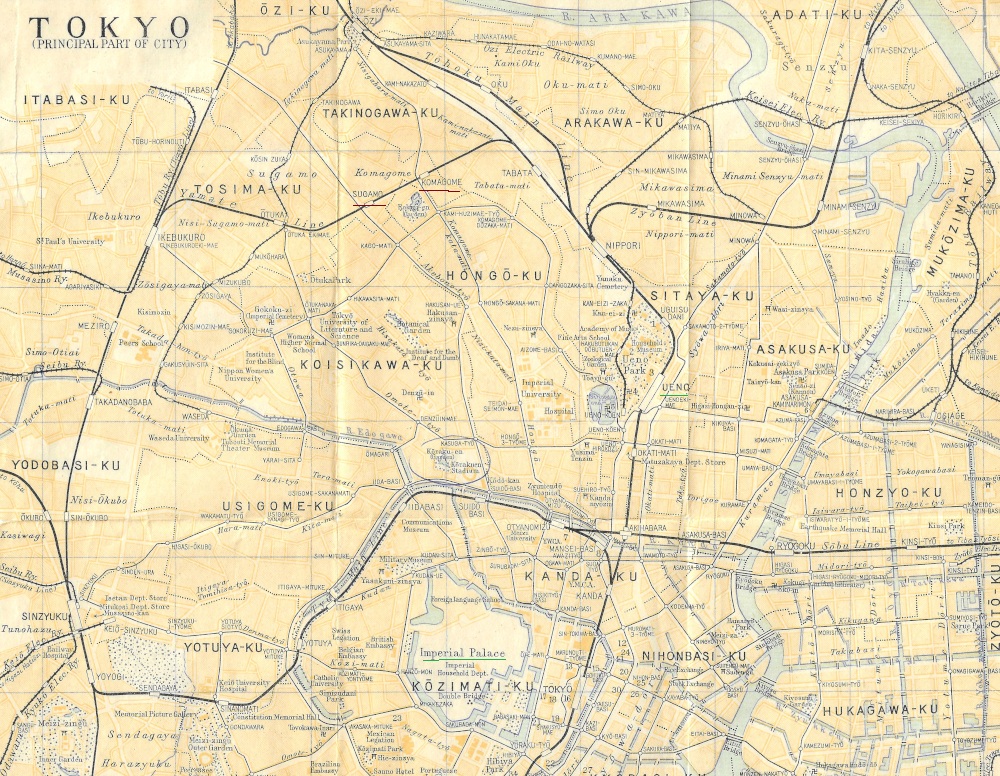
Map of Northern Tokyo, c.1941 Sugamo and Komagome are underlined in red, Imperial Palace and Ueno are underlined in green (Northwest of Ueno, Bunkyo Ward was formed in 1947 as a merger of Hongo-ku and Koishikawa-ku following Tokyo City's transformation into Tokyo Metropolis.) (Japan, The Official Guide, Board of Tourist Industry, 1941, between pages 240 and 241) The "nursery belt" which separated the urban area of the city proper from the rural area to the north was not an official administrative district. It was a functional zone spread across multiple villages, a major concentrated horticultural center. More than a geographic term, the local people thought of the area in terms of profession and function: uekiya-machi, "nurserymen's quarter" or "the nurserymen of Somei." Northern Edo became associated with: greenery, refined gardens, and a quieter, semi-rural lifestyle. Many nurseries supplied plants and expertise for large gardens, and some of these gardens and nursery-adjacent areas were later converted into public parks in the Meiji era. The nursery belt of Somei-Komagome-Sugamo-Sendagi allowed gardening to spread from elite daimyo estates to ordinary urban households where even small homes could display pots and seasonal plants. Although the former flower estates are gone, the surrounding area is dotted with garden-style temples and green spaces, allowing visitors to imagine the "flower viewing culture of Edo." Today, it's included in tourist courses along with Yanaka Ginza Shopping Street and Nezu Shrine, and the name Dangozaka is also used for cafes and Japanese confectionery shops.30 Please see also: our Bonsai Book of Days project listings for Sep 1 and Apr 20, plus Omiya Bonsai Nurseries, the Imperial Bonsai Collection, and this 1899 auction catalog. |
|
1 "Dangozaka (Sendagi district)," Japan Travel by Navitime. 2 "The Edo Period Gardening Craze," Meguri Japan. 3 Nippon Bonsai Association Classic Bonsai of Japan (Tokyo and New York: Kodansha International, 1989), pg. 148; Moore, Glenn and Cassandra Atherton "Shrine Forests, Bonsai and Public Parks in Tokyo: Old Trees as Symbols of Continuity," The Asia-Pacific Journal, Volume 19, Issue 6, No. 4, March 15, 2021. 4 Nippon Bonsai Association, pp. 150, 151-152. 5 Clark, Paul, PhD "JAPANESE HISTORY - 19th Century. 6 Watanabe, Miki "Gardeners' farmland in Komagome as seen in the "Ansei period Komagome Fuji shrine area map and illustration"," Japan Architectural Review, with lists of many farmers/gardeners -- which we will need to get back to when we have more details about the nurseries, Figure 8 has a Cadastral map from 1912 which lists several individuals named Takagi, Utsumi, and Shimizu but there is not a direct tie with either Tokichi or Ritaro Shimizu; 1856 Sendagi from Somei gardener per "Komagome Sendagi choo," Edo - the EDOPEDIA -. 7 Nozaki, pp. 25-26; O'Connell, Jean The Art of Bonsai; Science Digest, March 1970, pg. 38; The Gardeners' Chronicle, Vol. III, January 2, 1875, pg. 12; Lind, Gunter Art and Kimura". 8 Books, 1800-1849. 9 "Ukiyo-e drawn by Hiroshige Ando, One Hundred Famous Views of Edo, What's going on there now?," Axera; Not much info on the Takee Chronicle, but apparently it was known as Bukō nenpyō by Saitō Gesshin (1804-1878). 10 "Flower Pavilion, Dango Slope, Sendagi, No. 16 in One Hundred Famous Views of Edo," Brooklyn Museum. 11 "Yanesen - A Complete Travel Guide To Visit This Traditional Area in Tokyo," Sugoii Japan, January 3, 2026. 12 "Utagawa Hiroshige - One Hundred Famous Views of Edo - 16 - Spring - Sendagi Dangozaka Flower House - Commentary," Zipang Ukiyo-e Pottery Store, Nov. 21, 2025. 13 "'Dwarf Trees' from Robert Fortune's Books" ; Additional excerpts not specifically about dwarf trees but to add a little more depth to THIS page per "Yedo and Peking, Chapter VII. 14 The Birth of Omiya Bonsai Nursery -- 100 Years of History, The Omiya Bonsai Art Museum, Saitama, March 20, 2021, pg. 6; Nippon Bonsai Association, pg. 153. 15 Results from a few minutes of questioning of MS CoPilot Chat, 05/27/26 p.m., it mistakenly names Shonosuke of Okei-en (later Seiko-en) as the clearest documented exhibitor, instead of what the previous source states was Tokichi Shimizu of Seidai-en. Could both have been there? But per #29 (below) Seikouen's History, "Shounosuke's exhibition in 1892 during the time the business was called Oukei-en. What is exhibited here is a mountain azalea bonsai." ??? 16 "Tokyo Neighborhood Guide: Negishi, Taito, eHousing, August 1, 2024. 17 "Edo," Wikipedia. 18 Scott, Walter "The Influence of the West on the Development of Japanese Bonsai," Artistree Bonsai Blog, January 24, 2023. 19 The Birth of Omiya Bonsai Nursery, pp. 3-7. 20 Kuitert, Wybe "A Cherry Gardener in Tokyo's Ueno Park," Garden History 50, 1, 2022, pp. 109-112; for Kuitert's 2024 work on the Yohino Tokyo Cherry ("Somei-yoshino"), please see this. 21 Kinmonth, Earl "A Walk Through Tokyo Cemeteries Under the Somei Yoshino Cherry Blossoms," Sankei Shimbun, April 14, 2018. 22 "About the Ito Family," Sakura. 23 "Bonsai Book of Days, May 20. 24 "Great Kanto Earthquake," Wikipedia; Moore and Atherton. 25 "Omiya Bonsai Six Gardens." "Spanning five generations over 170 years" for Mansei-en reference on the web page (which originally was published in 2014) first shows up in mid-2019, giving a nursery start date of at least 1849. 26 "Nippon Medical School," Wikipedia. 27 "Konomachi Dictionary ~Toshima Ward~," Wa Mare; "Toshima - History," Wikipedia. 28 "Kokufuten." 29 "History," Seikouen; Valavanis, William N. The Passing of a Great Bonsai Master Tomio Yamada, March 17, 2026; Nozaki, Shinobu Dwarf Trees (Bonsai) (Tokyo: Sanseido Company, Ltd.; 1940), pp. 6, 96. 30 Results from a few minutes of deeper questioning of MS CoPilot Chat, 05/19/26 a.m.; "Print reproduction Paying homage to the ephemerality of Japanese nature - Flower park and slope of Dangozaka in Sendagi by Hiroshige," Bertico Designs. Note: In Japan there is another Dangozaka, a service area with a food court. This location is in Uenohara-City, Yamanashi Prefecture, about 36 miles or 58 km west of Tokyo. Still to be reviewed: Elias, Thomas S. "Mansei-en and the Kato Family: Part One," Bonsai Magazine, BCI, Vol. 40, No. 3, May/June 2001. |