|
This Page Last Updated: June 23, 2026 |
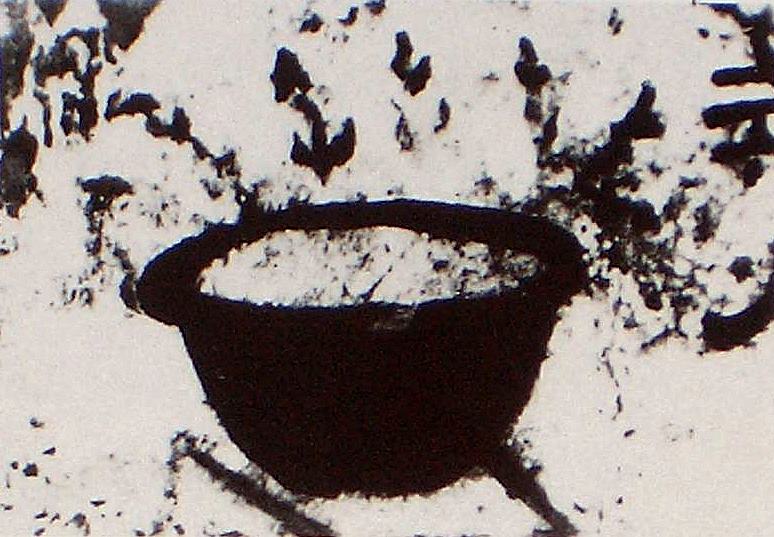
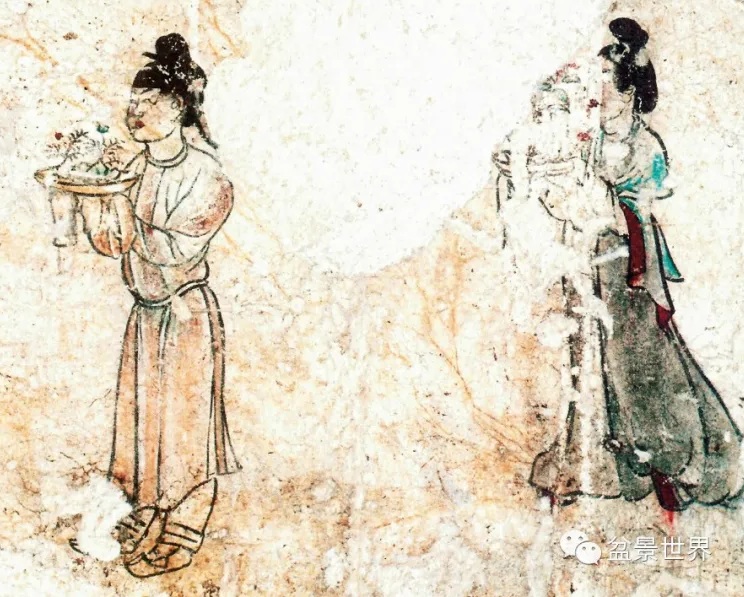
What depictions are there of this apparently already established and known garden art before that time? There is one earlier one that we know of so far: According to archaeological findings, potted flowers found in a mural in an Eastern Han Dynasty (25-220 C.E.) tomb in Wangdu County, Hebei Province, have been recognized as the embryonic form of bonsai by most experts in China. This graphic (top) is of what we can call a "proto-penjing" (or "proto-bonsai"). 2 Sun Cheng was a Chinese court eunuch, military general, and politician at the Imperial Chinese court during the Eastern Han dynasty. Contrary to the stereotype of Han eunuchs being corrupt and power-hungry, he was loyal to the imperial family and tried (unsuccessfully) to counter the culture of corruption. During Emperor An's reign (106-125 C.E.), those close to him, including the eunuchs Jiang Jing and Li Run and his wet nurse Wang Sheng, as well as his wife Empress Yan Ji, effectively ran the imperial administration, and used the opportunity to seize power and wealth for themselves. In 124 C.E., Jiang and Empress Yan accused the nine-year-old Crown Prince Liu Bao of crimes and persuaded Emperor An to demote him to Prince of Jiyin. In 125, Emperor An died suddenly around age 30, and even though Prince Bao was Emperor An's only son, Empress Yan, evidently wanting someone younger she could control, made Liu Yi, the Marquess of Beixiang, emperor. When the young emperor became gravely ill later in the year, Sun, who was then a mid-level eunuch, became concerned that Empress Dowager Yan would again bypass Prince Bao, the rightful heir, and so he entered into a conspiracy with a number of other eunuchs. They swore an oath to restore Prince Bao, and several days after the former Marquess of Beixiang died, they made a sudden assault on the palace and proclaimed Bao as Emperor Shun. After several days of battling with the Empress Dowager's faction, the eunuchs led by Sun prevailed, and the Yan clan was slaughtered. For their contributions to his restoration, Emperor Shun created Sun and 18 of his fellow eunuchs marquesses. (In ancient China, hóu was a noble rank created by King Wu of Zhou for rulers of newly conquered regions, and is generally translated as marquess or marquis. In imperial China, hóu is generally, but not always, a middle-to-high ranking hereditary nobility title. Its exact rank varies greatly from dynasty to dynasty, and even within a dynasty. It is often created with different sub-ranks, with liè hóu, Ranged Marquis, generally the highest.) Emperor Shun, whose temperament was weak, quickly fell under the control of the officials around him. In 126, when the eunuch Zhang Fang was accused of corruption by Yu Xu, governor of the capital district, he instead convinced the emperor that the accusations were false and that Yu should be sentenced to death. Sun and Zhang Xian, another eunuch who had helped put the emperor on the throne, interceded at great personal risk. Yu was spared, while Zhang was exiled. However, officials who were close to Zhang then accused Sun and his fellow eunuch-marquesses of being overly arrogant. Emperor Shun therefore sent them out of the capital Luoyang to their estates. Sun, angered by this, had his marquess seal and emblems returned to the emperor and secretly stayed in the capital, looking to find another chance to try to guide the emperor onto the right path. He was soon captured, but Emperor Shun, remembering his accomplishments, simply sent him back to his estate without further punishment, but also without listening to his advice on stamping out corruption. After gaining power, Sun Cheng intervened in cases of official misconduct and supported upright officials. He criticized corrupt eunuchs and officials and tried to steer the emperor toward better governance. There are no known books, essays, or treatises written by him. Eunuchs were primarily administrators and palace attendants, not scholars. Court eunuchs often operated behind the scenes rather than leaving written intellectual legacies. Later historians prioritized writings by Confucian scholar-officials over eunuch documents. In 128, Emperor Shun, remembering what Sun and the others had done for him, summoned them back to the capital, but largely again ignored their advice. In 132, Sun died and was buried with great honors, including the posthumous name Gang (literally "unbending"). 3, 4 The Soyakun Mural Tomb or Wangdu Han Tomb, is located in Suoyao Village (coordinates 38°42'36.540"N 115°9'10.152"E), east of Wangdu County, Hebei Province. (Hebei borders Shanxi Province to the west, Henan to the south, Shandong and Liaoning to the east, and Inner Mongolia to the north; in addition, Hebei entirely surrounds the direct-administered municipalities of Beijing and Tianjin on land. Suoyao Village is approximately 114 km or 71 miles north of Luoyang in Henan Province.) The Wangdu Han Tomb complex are two huge earth tomb buildings from the Eastern Han Dynasty. They face each other from east to west, about 30 meters or 98 feet apart. In March 1952, archaeologists began excavation work on the tomb on the west and numbered it as Tomb No. 1, namely Wangdu Han Tomb No. 1. This tomb carries not only the glory of the tomb owner -- the above Sun Cheng -- during his lifetime, but also a microcosm of the society of that era. Its occupant had been promoted from Administrator of Henan to one of the Three Excellencies and this was the tomb of a Han dynasty Marquis of Fuyang. Undisturbed for 1800 years, the murals in it are fresh and well-preserved. The tomb on the east was cleared from April to September 1955 and designated as Tomb No. 2. It was built on a larger scale than Tomb No. 1. However, due to repeated thefts, the No. 2 tomb chamber and the burial objects were seriously disturbed. The tomb wall murals could not be restored to their original state due to the collapse of the tomb chamber. However, the remaining parts show that its style is basically the same as that of Tomb No. 1. Judging from the text and other information on the unearthed brick land purchase certificates, Tomb No. 2 should be dated to the fifth year of Guanghe, Emperor Ling of the Eastern Han Dynasty (182 C.E.). Its occupant's surname was Liu, who had served as the Grand Administrator of Taiyuan. The two tombs are known as "Twin Mounds Rising in Elegance". 5, 6, 7 In the Eastern Han, the major burial types are the cliff tomb and the brick or stone chamber tomb, which are built underground or half underground, resembling dwellings, covered by a burial mound. There are chamber tombs constructed entirely of bricks, of a combination of bricks and stone, and of stone alone, without essential differences in tomb plan. They all contain several burial chambers with walls, doors, ceilings and sometimes columns. Chamber tombs built by a combination of bricks and stone blocks usually have large stone slabs as their door panels and walls, and use bricks to construct their barrel-vaults. Tombs built entirely of stone usually have stepped roofs, which are formed by shaped stone bars and blocks. Among the areas outside of Sichuan, it seems that stone-structured chamber tombs were popular in the area rich in stone sources, especially in Shandong and northern Jiangsu in the east, where rocky hills are densely distributed. In the metropolitan areas in central China, covered by loess, in Henan and Shaanxi, where the old capitals of the Han dynasty were located, brick-structured chamber tombs were the main burial type. Stone is only occasionally found in some large elaborate chamber tombs as key architectural features, such as the walls and door panels. It is very likely that by comparison with brick, stone was a more favored building material for chamber tombs. However, only a few regions had enough rocky mountain to use as the stone quarry for chamber tomb construction. In the areas lacking stone, people had to compromise on using bricks, the quality of which to some extent is similar to that of stone. In addition, bricks used for tomb construction were mass produced through standard molds. They were cheaper substitutes of stone and could be afforded by a wider range of people. In central China, over 10,000 small brick chamber tombs of commoners have been found. Most of them only have the space for one person inside. 8 Some of the brick chamber tombs also were decorated with frescoes, one of the best-known being the family tomb of the Marquis of Fuyang in Wangdu. (As a eunuch, Sun would not have had any children. Was he married, or who else from his family might have been interred?) This has murals depicting the various officials and attendants of the tomb master, causing the chamber to look like his official quarters. The tomb murals are artistic treasures left by the ancients. They carry rich information of the times and also contain the mainstream aesthetics and cultural customs of the times. Now, the tomb mural is different from the temple mural. It does not take the responsibility of enlightenment and helping human relations. Its audience is not human beings, but the deceased tomb owner and other invisible forces. From this point of view, Han tomb murals are not only used to record the life of the tomb owner, reflect his aesthetic interest, but also have the use of etiquette, bearing the important content of funeral culture. Ancient tomb paintings are painted in a closed and complete space, which is prepared for the tomb owner to enter another world. It reflects the living people's imagination of different space, and sometimes even a representation of the real world after optimization, with multiple attributes. 9, 10 Han tomb murals are part of a broader shift from earlier symbolic decoration toward rich pictorial storytelling, reflecting both beliefs about the afterlife as a continuation of earthly life and the growing importance of status display and moral order. The murals contain a painted wall scene showing attendants or servants, figures are rendered in profile with flowing robes, typical of Han funerary art, and objects around them (trays, stands, and furnishings) reflect elite domestic life. The seated or standing elite figures (likely the tomb owner) with the attendants or servants are in formal architectural settings such as elite residences or halls or pavilions. These scenes represent household management, bureaucratic authority, and the Confucian social hierarchy which was believed to continue unchanged in the afterlife. Unlike earlier abstract motifs, these murals tell coherent visual stories, guide the viewer's eye across space, combine multiple moments into a single composition. They function almost like a visual biography of the tomb occupant and a statement of identity and virtue. The smaller scale of the attendants show a lower rank and their body orientation has all attention directed at the central figure. Their postures and hand positions indicate that they are reporting or presenting information or are receiving commands in a formal and ritualized audience. Other panels from the same tomb (documented in scholarly literature) include flat trays or shallow basins, small plants or shrub-like forms rising from them with prominent placement indoors or on stands, not in open ground as mere decoration. These compositional cues are what identify them plants clearly separated from the ground, grown in deliberate containers, displayed in elite or indoor settings, miniaturized and styled rather than ordinary garden vegetation. Nature has been miniaturized, ordered, and brought under elite control. Daoist Naturalism is present by showing the cosmos in miniature, harmony between humans and nature, and the "essence" of a landscape is captured in small form. The ideal Han elite do not just rule people -- they harmonize and regulate the natural world itself. And the potted plant is part of Sun Cheng's personal cultivated world. 11, 12 From the entrance of the tomb inward there is a sloping entrance passage (tomb corridor, representing the movement inward toward the tomb, the passage from life to afterlife), the Antechamber (front chamber with servants, storage scenes, and daily activities), and the Main burial chamber (rear chamber, the symbolic "core" of the tomb and the idealized life of the tomb owner). (Sometimes in these tombs there might also be small side niches or subsidiary spaces.) The deeper you go, the more symbolically important and private the space becomes. 12 In May 1982, the Wangdu Han Tomb complex was designated as a cultural relics protection unit in Hebei Province. In June 2006, it was included in the sixth batch of national key cultural relics protection units. In 2009, the county established the Wangdu Han Tomb Museum, repaired the murals in the tomb, reinforced the roof of the tomb chamber, and installed moisture-proof devices for the murals. It was expected to be completed and open to the public in October 2010. 5 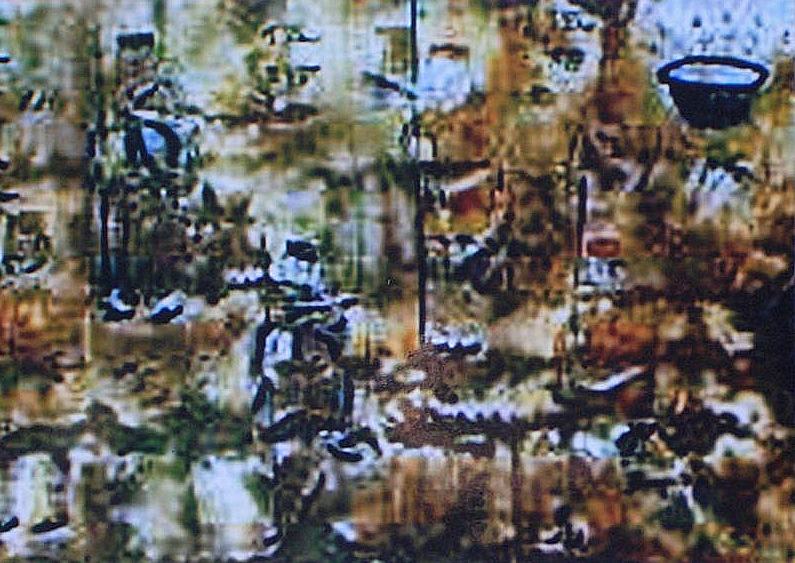
"Plants in earthenware pot (upper right) from Eastern Han (25-220 C.E.) tomb mural" (from Wei Jinsheng, "Brief History of Penjing," World Bonsai Friendship Federation, Fig. 2., Feb. 10, 2010)
"Detail of plants in earthenware pot from Eastern Han (25-220 C.E.) tomb mural" (from Wei Jinsheng, "Brief History of Penjing," World Bonsai Friendship Federation, Fig. 2., Feb. 10, 2010) The appearance of a "proto-penjing" (miniature garden or potted landscape) in the murals of Sun Cheng's tomb is not accidental -- it reflects key ideas about status, nature, and the afterlife in the Eastern Han period. They are depictions of cultivated plants in containers or stylized garden settings. These images show that by this time, elites were already appreciating controlled, miniature representations of nature. Officials are shown with attendants, architecture, gardens, and cultivated plants. A proto-penjing signals wealth and leisure, refined taste and cultured living, and association with elite garden culture. For a high-ranking figure like Sun Cheng (a marquis), this imagery reinforces his identity as someone who enjoyed elite courtly life, including garden aesthetics. Miniature landscapes often symbolize mountains, sacred peaks, or paradisiacal realms. In early Chinese thought, especially Daoist-influenced ideas, mountains were homes of immortals, and cultivated plants and strange rocks could evoke cosmic harmony and longevity. A proto-penjing in a tomb mural can therefore signify a wish for cosmic order in a microcosm of the universe as a portable paradise for the deceased in a pleasant afterlife realm. 4 This predates the first well-known penjing images (e.g., Tang dynasty, 7th-8th c.) and shows the concept existed hundreds of years earlier than previously thought. 11 Please see also: our Bonsai Book of Days project listings for Jul 2, and the legend of a contemporary to Sun Cheng, Fei Jiang-fang, and a slightly later TaoYuenming. |
|
1 "CHINA -- Up to the SONG DYNASTY (to the year 960 C.E.). 2 Zhou, Wu-Zhong and Xiao-Bai Xu "Penjing: The Chinese Art of Bonsai," Hort Technology, 3(2), April/June 1993, pg. 150. 3 "Sun Cheng," Wikipedia. 4 Results from a few minutes of questioning of MS CoPilot Chat, 06/16/26 a.m.. 5 "Soyakun Mural Tomb, with imTranslator, 06/16/26. 6 "A large tomb was excavated in Wangdu, Hebei Province," 04/29/2026, with imTranslator, 06/16/26. 7 "Wangdu County," BaiduWiki. 8 Chen, Zuan "Eastern Han (AD 25-220) Tombs in Sichuan," Originally as a thesis submitted in partial fulfillment of the requirements for the degree of Doctor of Philosophy University of Oxford Trinity Term 2014, then published by Archaeopress Archaeology in 2015, both pp. 4-6. 9 Wang, Zhongshu Han Civilization, New Haven: Yale University Press, 1982, pg. 178, translated by K. C. Chang and Collaborators. 10 Wu, Bingyu "Analysis on the Research Methods of Murals in the Tombs of the Han Dynasty, Atlantis Press, Advances in Social Science, Education and Humanities Research, volume 572, Proceedings of the 7th International Conference on Arts, Design and Contemporary Education (ICADCE 2021), pp. 348, 349, 350. 11 Results from a few minutes of questioning of MS CoPilot Chat, 06/03/26 a.m.. The original final paragraph above contained information about four panels that were supposely in the mural, each panel containing a early version of different proto-penjing compositions. This has been removed as further questioning MS CoPilot Chat, 06/23/26 p.m. revealed that the panels were indeed apparently an AI hllucination. 12 Results from a several minutes of deeper questioning of MS CoPilot Chat, 06/15/26 a.m.. Still to be reviewed: Beijing Historical Museum, Hebei Provincial Cultural Relics Management Committee, Wangdu Hanmu Bihua (Wangdu Han Tomb Murals), Beijing: China Classical Art Publishing House, 1955. 14 pp. text, 36 plates, four in colour, 20 figures. A detailed description of a tomb excavated by the provincial authorities in 1952 at Wangduxian, Hebei. The remains of the wall paintings are illustrated by line drawings, photographs and colour reproductions. In Chinese. Per Hanshan Tang Books, Ltd., London, List 169, pg. 24, No. 254; and noted by Bingyu Wu as Reference to Footnote 14, pg. 356. |