SOME RECENT SHOWS, 2025 - 2017, TEXT PLUS VIDEO LINKS
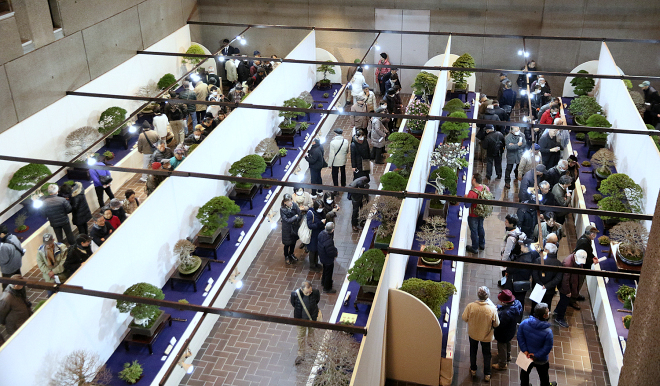
For Part 1 of 2025 it seemed as though there was a larger number of junipers and pines compared
with deciduous species. Like in past exhibitions, there were fewer rock plantings and
forests but more literati style bonsai were displayed. The Japanese flowering apricot
bonsai were well represented, and in blossom too. There was a good representation of
Zuisho Japanese five-needle pine bonsai. In part due to the good weather, over 1,000
visitors saw the show every day.
Five Kokufu Prizes were awarded to outstanding bonsai. Unione Bonsaisti Italiani (UBI)
member Giovanni Americano won a Kokufu Prize with his Acer Buergerianum bonsai
root-over-rock. There were 13 Important Bonsai (kicho) shown. As always
all the bonsai were beautiful and simply displayed to allow their beauty to shine.
Four Kokufu Prizes were given in the second part.
|
In Part II of the 2024 98th Kokufu Ten there were 12 bonsai displayed by owners from foreign countries: Germany,
Sri Lanka, Italy, Spain, China and the U.S. (Of course, these were Japanese-trained bonsai and we doubt if
the owners ever watered these plants.)
The 61st Exhibition of Suiseki Masterpieces was held on February 14-17, but in a different gallery on the 2nd
floor. This is the main suiseki exhibition of the Nippon Suiseki Association. It has replaced the
ten previous exhibitions held in the past. Kunio Kobayashi and Seiji Morimae headed up the NSA.
There were 74 general exhibits, 28 special entries, 20 Alcove Displays, and 18 Foreign Entries (Italy, Germany,
Philippines, Viet Nam, Thailand, Australia, France, Denmark, and USA). The NSA made a major change to
its exhibition program involving the annual Meihin-ten and Japan Suiseki Exhibitions. Beginning in 2024,
the Meihen-ten Suiseki Masterpiece exhibition has shifted from its Meiji Shrine venue to the Tokyo Metropolitan
Art Museum. The name Japan Suiseki Exhibition is being dropped and replaced with the Exhibition of Suiseki
Masterpieces. Instead of organizing two major viewing stone exhibitions each year in Tokyo, the association
is reducing that to a single exhibition held in February. This major change may be due to the continued
shrinking of the number of suiseki collectors in Japan combined with the limited resources of the NSA to stage
two exhibits and publish two exhibit catalogs each year. The first exhibition of Japanese Suiseki Masterpieces
(the Meihin-ten) was held in 1961 and continued each year until 2012 when the NSA held the first exhibition in the
Art Museum. This venue attracts more visitors than the Meiji Shrine site, and the combination of two related
exhibits, bonsai and stones, make it more attractive to foreign visitors. This proved successful as more
foreign exhibitors participated in the Japan Suiseki Exhibition.
|
The 2023 Kokufu Bonsai Exhibit was forecast to be full of foreigner visitors because they had not been
allowed to enter Japan for almost three years. The aisles appeared to be wider, probably because of COVID-19
restrictions. Everyone entering the Museum had to wear a face mask and sanitize their hands. Non-Japanese
exhibitors were significant in Part I: 2 USA, 4 Italy, 2 Germany, 1 Thailand, 1 England, and 1 China.
Part II had 1 each from Italy, Thailand, and Sri Lanka.
The 10th Japan Suiseki Exhibition was held at the Tokyo Metropolitan Art Museum in Ueno Park, Tokyo, on February
14-18, 2023. Kunio Kobayashi and Seiji Morimae head up the Nippon Suiseki Association. The suiseki
exhibition is held in a 2nd floor gallery which is carpet covered. No water is allowed in this exhibition
room, which is why water is not included in the water basin displays of suiseki, the traditional and
formal way of appreciating suiseki. Also, that is why there are no accessory plantings displayed with the
stones. There were 8 Featured Entries, 32 Alcove Displays, 1 Guest Entry from the Hosokawa School of
Bonseki titled "Surging Sea," 78 General Exhibits, 22 International General Exhibits from the United States,
Italy, Germany, Switzerland, Vietnam, Australia, and Taiwan.
|
Part 1 of the 2020 Kokufu Bonsai Exhibition had 151 exhibits. These included 106 large-size, 39
medium-size, and seven shohin compositions. There were seven special exhibits including a Suiseki
special exhibit, plus a juniper, a Pinus parviflora, and a deep large ceramic pot ("owari sapphire-colored
decorated suiban") from the Imperial Household. Two of the show's bonsai compositions did include a suiseki.
Mr. Toru Suzuki was the Chairperson of the Kokufu Exhibition.
Part 2 of the 2020 Kokufu Bonsai Exhibition also had 151 exhibits. These included 106 large-size, 39
medium-size, and seven shohin compositions. One of the seven special displays in this part was a
Deodor cedar, Cedrus deodara, a common garden tree extremely rare to see trained for bonsai, which was
from the famous Keiunan Bonsai Collection of Mr. Tanaka and was once owned by Prime Minister Shigeru Yoshida.
There was one Suiseki special exhibit, but four bonsai compositions included a suiseki. Mr. Yukizyuou Nakano
(Gyozan) specializes in large unglazed containers, but also hand-makes smaller and glazed pots too. Mrs.
Nakano is a talented artist as well and often hand-paints scenes on containers her husband makes. There were
96 large bonsai displayed in the main gallery and 10 were planted in Gyozan containers which equates to 11% of the
large bonsai in the main gallery being made by Gyozan.
The 7th Japan Suiseki Exhibition was held on February 14-18, again, in the same building as the Kokufu Bonsai
Exhibition, but on a different floor. There were seven special entries, 32 alcove displays and a
guest entry of a bonseki from the Hosokawa School. Members displayed 89 suiseki in the general
entries. The foreign entries included suiseki from: Philippines, Italy, Denmark, Germany, Vietnam,
Australia, China and the United States. There were 21 suiseki in this category. Starting this
year, the organization would be having a special exhibit featuring 22 suiseki from famous rivers which had
produced excellent suiseki. In total, there were 171 suiseki and one bonseki in this exhibition. |
Part 1 of the 2019 Kokufu Bonsai Exhibition had 151 exhibits. These included 97 large-size, 47 medium-size,
and seven shohin compositions. Fewer trees were displayed this year. This was clearly evident
with the removal of one entire row against a far wall and hanging large photos of blossoming satsuki azalea bonsai,
with the cultivars in English too. This served two purposes: making wider aisles and adding color to a
relatively winter bonsai appearance. The ten fewer bonsai was well compensated by the high quality
specimens. Two other changes could be noticed: The two special exhibits -- one from the
Imperial Bonsai Collection -- were moved and, also, the small room
with shohin and medium-size bonsai had been rearranged.
Part 2 of the 2019 Kokufu Bonsai Exhibition also had 151 exhibits. These included 108 large-size, 36
medium-size, and seven shohin compositions. The Kokufu Award was given to five trees.
The Trident Maple which won an Award in this Part was under the care of Shinji Suzuki. One of his client's
bonsai also won a Kokufu Award in Part 1. Officials estimate that approximately 1,200 people have visited
the exhibition daily. |
The 6th Japan Suiseki Exhibition was held at the Tokyo Metropolitan Art Museum in Ueno Park, Tokyo, on
February 14-17, 2019. This was the same venue as the Kokufu Bonsai Exhibition, but in a different gallery
on the 2nd floor. Seiji Morimae was able to get a five year contract to hold this prestigious exhibition
of stones, and it looked like it will likely continue with his and Kunio Kobayashi's leadership of the Nippon
Suiseki Association.
Part 1 of the 2018 Kokufu Bonsai Exhibition had 179 exhibits with a total of more than 221 individual bonsai
specimens. These included 116 large-size, 41 medium-size, and four shohin compositions with 23
individual trees. It is interesting to note the current way of creating shohin bonsai compositions:
usually a box stand is used with an evergreen tree on the top. It faces one way or the other, but it
always leads your eye to a side bonsai lower down, often a cascade style evergreen. This style of display
is often seen as boring or static, however, by Westerners.
Part 2 of the 2018 Kokufu Bonsai Exhibition had 161 exhibits with a total of about 224 individual bonsai
specimens. These included 114 large-size, 43 medium-size, and four shohin compositions with 24
individual trees.
Congratulations go to Shinji Suzuki whose clients won three out of the four 2018 Kokufu Prize winners. He is
responsible for displaying and preparing the bonsai for his clients, but not necessarily for their creation.
Masterpiece bonsai of this quality take many decades to develop and are bought and sold frequently. Each
time they change hands they usually improve in quality. It is not uncommon to see a famous bonsai in
different gardens every year.
Masahiko Kimura had worked on 55 pieces that were on display, which is down from over 70 a few years ago.
Still, that's a staggering number to be proud of considering about 445 bonsai were displayed this year.
|
|