Oblique references to the
Chinese side of dwarf potted tree history in English can be found in Staunton's 1797 account of
Lord Macartney's embassy: "To produce them formed
a part of the [Chinese] gardner's [sic] skill, and was an art invented in that country." The earliest rendering into a European language of the Chinese history in some detail was in Rolf A. Stein's 1943 book-length monograph "Jardins en miniature d'Extreme-Orient." This still remains the most detailed investigation into the religion, cosmology, and magic of the region. It was reprinted in an English translation (The World in Miniature, Stanford, CA: Stanford University Press, 1990, of a 1987 French revision) with two other articles further examining ties with the domestic and religious architecture of East Asia. A truly monumental work. (The original edition has not been reviewed yet to determine what early works it cited and which were first cited in the later edition. Some later archaeological and other findings were definitely incorporated in the 1987 revision.) So far, the earliest known history of some length in English is H.L. Li's Chinese flower arrangement (Philadelphia, PA: Hedera House; 1956), an apparently little-known work which, despite the title, contains much about the culture of table plants/tray gardens (pp. 4-10+).
[The earliest known convention presentation in
the West, "The History of Bonsai in China," was made by Richard D.
Darrah of Pittsburgh, PA in mid-July 1971 at the American Bonsai
Society Symposium in Norfolk, VA. He used a set of 30 slides with an
accompanying narration which he had been given by Wu Yee-Sun.
(per "Chinese Bonsai" by Richard Donald Darrah,
Journal, ABS, Vol. 5, No. 3, Fall 1971, pg. 56)]
In 1987, Hu Yunhua's Chinese Penjing, Miniature Trees and Landscapes revealed many samples of the ancient poetry and literature which mentioned dwarf potted trees, as well as many regional style details (Portland, OR: Timber Press, ISBN 0-88192-083-5, pp. 128-130+). Still to be delved into is Li Shuhua's A Cultural History of Chinese Penjing, 2nd edition, 2019, ISBN: 978-7-5219, 712 pp.JAPANESE DEVELOPMENTS The earliest known reference in English to the Japanese part of the history of dwarf potted trees was apparently in the 1901 lecture by Toichi Tsumura given before the Japan Society of London (pp. 12-13). Shinobu Nozaki's 1940 work, Bonsai, provided the first detailed listing of plants used during the different periods of the artform's development in Japan in the 19th and 20th centuries. (Tokyo: Sanseido Company, Ltd., pp. 23-27). Soen Yanagisawa's Tray Landscapes (Bonkei and Bonseki), 1st edition 1955, gave the first detailed history of those related artforms (Tokyo: Japan Travel Bureau, LCC #62-19637, throughout).
The 1970 Nippon Bonsai Taiken
(Bonsai Masterpieces) (Tokyo: Seibundo Shinkosha Publishing
Co., Ltd.; 1972. Compiled by the Japan Bonsai Society, Inc.
First edition in Japanese April 29, 1970) included a 20 page "Brief History
of Bonsai" by Asst. Prof. Ryoji Iwasa of Chiba University (pp. 330-349).
However, this went untranslated for the 1972 English companion booklet. (Iwasa
also wrote the history text Bonsai Bunka-shi (Tokyo: Yasaka Shobo; 1976).)
In 1989, the Nippon Bonsai Association's Classic Bonsai of
Japan volume had a chapter which provided a comprehensive look at the history of both the physical and
metaphysical approaches to the art by Hideo Marushima (Tokyo and New York: Kodansha, ISBN 0870119338, pp.
140-156). (Marushima in 1982 also published Nihon Bonsai Bonseki Shiko (An Interpretive
History of Bonsai and Suiseki [sic]), as well as Chugoku bonkei ga
Nihon bonsai ni ataeta rekishiteki eikyo ni kansuru jisshoteki kenkyu (Studies on the Historical Influences
of Chinese Penjing on Japanese Bonsai) (Tokyo: Gihodo; 1998), neither of which has yet been translated into English. See also below.)
WORLDWIDE DEVELOPMENTS
The first truly cosmopolitan view of the history can be found
in Deborah R. Koreshoff's 1984 Bonsai: Its Art, Science, History and Philosophy (Brisbane: Boolarong
Publications, ISBN 0-908175-75-2; also, Portland, OR: Timber Press, ISBN 0-88192-389-3, 1997, pp. 1-11+).
THE PRINCIPAL HISTORIANS
The more recent bonsai historians include:
Peter Aradi (b. 1937), grew up under Nazi and Communist-controlled Hungary, escaped in 1956 and spent several
months in refugee camps before he "had the opportunity and privilege to immigrate to the U.S." He worked for the
Associated Press during the 1964 Tokyo Olympics. He was later adjunct instructor of History and Humanities at
several Tulsa, Oklahoma area colleges. He has been researching the cultural history of bonsai. He wrote
at least nine articles for the American Bonsai Society's Journal since 1997, including a six-part series on
"Visiting With the Masters," as well as an article in 2003 for International Bonsai about the 1964 Olympic
Commemorative Bonsai Show. (See Oct 10 entry) He is a retired information
systems professional. In the summer of 2006 he moved to San Antonio, TX.
SEE ALSO: Nov 4 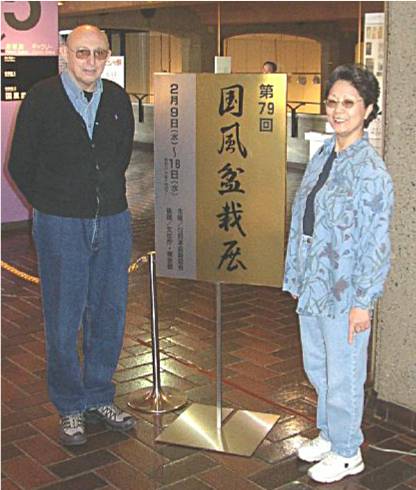
Peter & Shigemi Aradi at the 02/2005 Kokufuten. (Photo courtesy of Alan Walker, 05/11/07) Robert J. Baran (b. 1955), researcher for the Magical Miniature Landscapes project (various iterations of this web site since 1999). He wrote four articles for the ABS Journal between 1991 and 1996 (reproduced on this website), the book Designing Dwarfs in the Desert (1997), and part of the chapter "The origins of bonsai" in Craig Coussins' The Bonsai School (2002) and parts of his 2011 history article for bonsaiempire were then included in their 2014 e-book, The Bonsai Beginners Guide, based on material from this web site. He also created and authored the text for The Bonsai Coloring Book (2005). His Bonsai CV is here. 
Robert J. Baran, 2023. Peter Del Tredici, Curator of the Larz Anderson Collection of Japanese Dwarfed Trees at Harvard's Arnold Arboretum since 1984. He had started there as apprentice to the curator in 1979. He is also a Senior Research Scientist at the Arboretum and a Lecturer in Landscape Architecture at the Harvard Graduate School of Design. His 1989 article "The Larz Anderson Bonsai Collection of the Arnold Arboretum" in the Arnoldia 49(3):2-37 was reissued that year as the book Early American Bonsai, The Larz Anderson Collection of the Arnold Arboretum. Following his presentation of that story at the 2002 International Scholarly Symposium on Bonsai and Viewing Stones in Washington, D.C. and some additional research, a revised version was published in 2006 as "From Temple to Terrace, The Remarkable Journey of the Oldest Bonsai in America" in the Arnoldia 64(2-3):1-64. In 1993, his article "Ginkgo Chichi: In nature, legend and cultivation" was published in International Bonsai 93(4):20. Some other articles can be found here. A non-bonsai segment of Peter discussing dwarf conifers can be seen in this 2005 episode of People, Places, and Plants (the 12:05 to 17:30 mark of this video).
Dr. Thomas S. Elias (b. 1942),
Director of the U.S. National Arboretum in Washington, D.C. from 1993 through 2009, he played a key role in the development and
oversight of the National Bonsai & Penjing Museum. During his tenure as Director, the Museum underwent considerable
expansion of its physical plant and extensive expansion of its living collections, library, and museum artifacts. He was
been instrumental in obtaining hundreds of rare and out-of-print books and serial publications, particularly from Japan, for the
Museum's collections. He has served since 2000 as the historian for Bonsai Clubs International's Bonsai Magazine,
contributing nearly a dozen articles including the two-part series "Mansei-en and The Kato Family" (2001). He serves as
International Consultant to the World Bonsai Friendship Federation. He has studied the plants of Asia and North America for many
years and is the author of at least seven books and numerous papers on wild plants, trees, and threatened species in America. A
detailed history of bonsai which Dr. Tom presented at the 2002 International Symposium and then expanded for the
2005 WWBF Convention can be found
here.
Dr. Tom retired at the end of 2009 and a detailed biography of him can be found
here in the Winter 2009
Newsletter of the National Bonsai Foundation. At the end of 2011, Dr. Tom and his wife, Dr. Hiromi Nakaoji, established the
Viewing Stone Association of North America with the website, http://www.vsana.org/, which further
presents and archives detailed information. SEE ALSO: Dec 30 
Dr. Thomas S. Elias. (Photo from http://web.archive.org/web/20071214145533/http://www.bonsai-wbff.org/wbc5/images/presenters/Telias2.jpg) Hu Yunhua (b. 1943), curator of the Penjing Garden at Shanghai Botanic Garden, wrote Penjing: The Chinese Art of Miniature Gardens (1982), The Art of Chinese Miniature Landscapes (1987), and Chinese Penjing, Miniature Trees and Landscape (1989). These works contain much information about the history of that art. 
Hu Yunhua, c.2011. (Photo from http://www.cherylpetty.com/bonsai-and-penjing/shanghai-botanical-garden/)
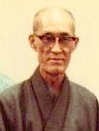
Hideo Marushima was Japan’s leading authority on the history of both bonsai and
suiseki. He wrote the chapter "The History of Bonsai" in the
Nippon Bonsai Association's Classic Bonsai of Japan (1989); the article
"A
Historical Study on the Names of Chinese Penjing and Japanese Bonsai" (Lands. Stud.
1996; 60:36-45); and he was the author of many books on this subject including History of
Japanese Stones (1992), Studies on the Historical Influences of Chinese Penjing on
Japanese Bonsai (1998), and the three volume The World of Chinese Penjing
(2000) co-authored with Hu Yunhua. Mr. Marushima was an attorney in Tokyo.
He died on April 14, 2006.
Aarin Packard was assistant
curator of the National Bonsai and Penjing Museum before becoming curator of the Pacific Bonsai Museum
towards the end of 2014. His previous blog Capital
Bonsai had a few articles touching upon aspects of bonsai history. More presented research is
looked forward to.
Iwasa Ryoji (fl. 1970's), professor emeritus at Chiba University and one of the pioneering historians
of bonsai history. His book from 1976 is Bonsai Bunka-shi (Historical study on the bonsai development in the
social backgrounds), so far not translated into English.
Phan Van Lit with Lew Buller wrote Mountains in the Sea: The Vietnamese Miniature Landscape Art of Hòn Non Bô
in 2001. This was many persons' introduction to the Vietnamese form of magical miniature landscapes.
William N. Valavanis (b. 1951), studied in the garden of Kyuzo Murata
in Omiya, Japan, graduated from The State University of New York Agricultural and Technical College at Farmingdale,
Long Island, NY with a degree in Ornamental Horticulture, returned to Japan to study bonsai with Kakutaro Komuro and
Toshio Kawamoto, bonsai chrysanthemums with Tameji Nakajima, and earn a master's teaching certificate in ikebana
from the Shofu School. A degree in Floriculture and Ornamental Horticulture from Cornell University followed
in 1976 on the heels of several months study at Yuji Yoshimura's School of
Bonsai in Briarcliff Manor, NY. Bill began publishing the International Bonsai magazine in 1979 (until
2020) and would continue to teach classical bonsai art. Through the years he has given several talks on the
subject at various locations, and his latest project is the on-going development of a Powerpoint program on the "History
and Influence of Japanese Classical Bonsai." His 2013 work, Classical Bonsai Art, A Half Century of Bonsai Study
(International Bonsai) highlights the development over the years of 100 trees in his personal collection and also acts as a
detailed presentation of the principles of the art, including the shohin compositions. SEE ALSO:
Sep 3 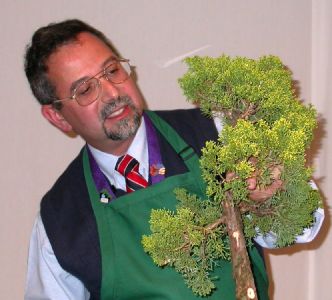
William N. Valavanis, 04/11/2003 workshop. (Photo courtesy of Alan Walker, 05/11/07) Yuji Yoshimura (1921-1997) was responsible for the West learning classic Japanese bonsai. Besides his very influential and still relevant book from 1957, The Japanese Art of Miniature Trees and Landscapes (co-written with his student Giovanna M. Halford), his historical article output in English includes "Bunjin-Gi," Bonsai Magazine (BCI, Vol. XXVII, No. 6, November/December 1988, pp. 3-7); "Modern Bonsai, Development Of The Art Of Bonsai From An Historical Perspective," Parts 1 - 4 (International Bonsai, IBA, beginning 1991/No. 3, translated by Craig W. Risser from the Japanese article originally published in the 1990/3 issue of Bonsai Gakkai (The Journal of Bonsai Science)); and 1984's The Japanese Art of Stone Appreciation, Suiseki and Its Use with Bonsai, which he co-wrote with Vincent T. Covello. Most of Yuji's historical notes went to Bill Valavanis after the Japanese master's passing in 1997. Chris Cochrane (1949-2024), although little published in the bonsai specialty magazines, this Virginia resident studied and collected in Japan and elsewhere. His two primary fields were viewing stones and display. He has been the moderator of the Internet Bonsai Club's "Suiseki, Viewing Stones and Scholars' Rocks" gallery, where he often shared insights as to the wonderfilled and subtle details of his areas of interest. He was known to be working on a "Viewing Stones Timeline." He was listed as a Contributor to the Patrick Taylor-edited work The Oxford Companion to the Garden (Oxford University Press, 2006), for the article "bonsai." SEE ALSO: Dec 23. 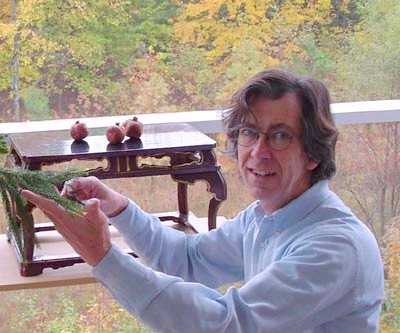
Chris Cochrane, 11/2002. (Photo courtesy of Alan Walker, 05/11/07) Dr. Gunter Lind was a professor of physics education at the University of Kiel in Germany. His main fields of research were the history of physics teaching in Germany and empirical research on expertise (comparing physics "experts" and "novices" according to cognitive aspects of learning and problem solving). He turned to bonsai seriously only after retiring and had started a website on history and philosophy of bonsai within the German www.bonsai-fachforum.de. His main interest was in the stylistic aspects of bonsai. "On the 9th of April 2007 Prof. Dr. Lind died after severe illness. He had dedicated most of his time after his retirement to the exploration of bonsai history. It took a very competent bonsai and art connoisseur to disclose a field of knowledge that is so completely unknown in the west." (Per Peter Krebs' notes at the end of Dr. Lind's article "Art and Kimura".) SEE ALSO: Apr 9
* * * * *
The term "bonsai" in print in an English work dates from at least the year 1899, Yamanaka & Co. Auction Catalog," p. 7). The term "P'oon Tsui" (an English transcription of the Cantonese pronunciation of "pen zai" ["pen tseye"] dates from at least 1933 (McClure, pg. 119).See also this survey of Term Origins.
* * * * *
In addition to Koreshoff and Wu above, there have been other researchers whose specific work paralleled some of my own studies. They were discovered after I had independently touched upon some of their findings and additional material. These include: Killam, Walt "Bonsai in Ukiyo-e," Bonsai Magazine, BCI, Vol. XVIII, No. 1, January/February 1979; Keith S. Scott's Letter to the Editor in the Bonsai Journal, ABS, Vol. 1, No. 2, pg. 11, where he mentions that he is "compiling a complete bibliography of all articles on bonsai written in English... [having] located nearly all the articles listed in The Reader's Guide to Periodical Literature since 1900 and a list of all the articles from the New York Times..."; and Takase Studios' page with Bonsai Calligraphy, ©2000, accessed 03/05/01. |